

A great soccer defence drill is more than just running through cones; it’s where you turn your defensive philosophy into muscle memory. The best drills don't just create players who can tackle. They build smart, proactive defenders who see threats before they happen and work together to shut them down, turning a solid back line into the team's biggest strategic advantage.
The Mindset of a Modern Defender
Gone are the days when defending was just about last-ditch tackles and hoofing the ball clear. Modern defending is a craft built on organisation, constant communication, and collective brainpower. It’s about solving problems before they turn into shots on goal.
A strong defence isn't just a safety net; it’s the launchpad for every single attack. The drills in this guide aren't just physical warm-ups. They're designed to forge the habits and mindset of an elite defensive unit, teaching players why they're moving, not just where to stand.
The Four Pillars of a Rock-Solid Defence
To build a backline that's genuinely tough to break down, every player needs to live and breathe four key principles. They all work together, creating a unit that is not only solid but can instantly flip the switch from defending to attacking.
- Pressure: The first defender's job is simple: get to the player on the ball. The goal isn't always to win the ball back immediately. It's about closing them down, rushing their decision, and forcing a predictable pass or a mistake. Controlled, intelligent pressure is everything.
- Cover: While one player presses, their teammates have to provide cover. This means getting into positions that protect the space behind the pressuring defender. They're anticipating the next move, ready to intercept a pass or become the next player to apply pressure.
- Balance: The rest of the unit has to stay balanced across the pitch. Defenders away from the ball should be tucking in, covering dangerous spaces and marking players, making sure the team can’t get sliced open by a quick switch of play.
- Compactness: Finally, the whole team—not just the back four—has to stay tight, both from front to back and side to side. This shrinks the pitch for the opposition, cutting off passing lanes and making it incredibly difficult to play through the lines.
From Reacting to Reading the Game
This organised approach isn't new. In fact, some of the earliest data analysis in football started shaping how coaches thought about defending decades ago. Charles Reep's work with clubs like Brentford FC in the 1950s was groundbreaking. By tracking hundreds of matches, he showed that most goals came from short, quick attacks, exposing how easily defences could be caught out by direct play.
This discovery forced coaches to drill their teams on reacting to rapid transitions—a principle that’s still at the heart of every modern defensive strategy today.
"Great defending is not about making spectacular tackles. It's about being in the right place so you don't have to make a tackle at all." – A common coaching maxim.
This shift towards proactive thinking is what separates good defenders from great ones. A coach’s job is to build this foresight in players, teaching them to read the game's cues and anticipate what the opponent will do next. Understanding the roles of sports coaches is fundamental to creating this kind of tactical intelligence.
Today, we've got tools that give us incredible insights into these principles. For example, using a GPS tracker from SoccerWares lets coaches measure a player’s work rate, positioning, and recovery runs with cold, hard data. It can show you if your midfield is truly staying compact or if your fullback is providing proper cover, turning abstract coaching points into real, measurable stats.
Mastering Individual Defensive Scenarios
Before a back four can ever hope to work together, each player has to win their own individual battles. It’s that simple. Great defending starts with mastering the one-on-one duel, whether you’re a centre-back holding up a striker or a fullback stuck on the touchline with a tricky winger.
This section is all about getting those fundamentals right—the techniques that build a defender's confidence from the ground up.
Building this individual skill comes down to a few core principles. Think of it as a mental checklist that every defender should run through when they’re about to engage an attacker.
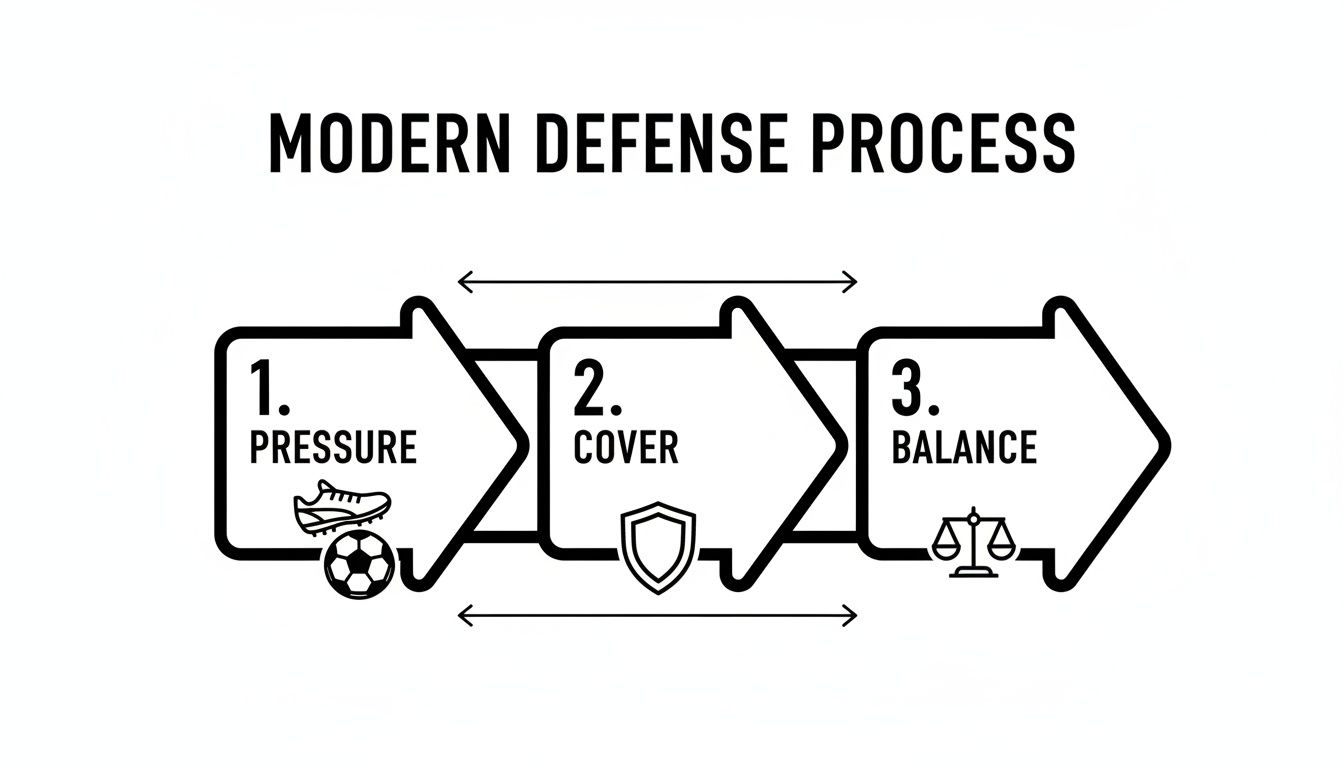
This sequence—Pressure, then Cover, then Balance—is the key. It’s what turns a chaotic moment into a controlled, winnable situation for the defender.
The Classic 1v1 Winterbottom Duel
This is a cornerstone of defensive training for a reason. Simple, effective, and it isolates the pure 1v1 battle, forcing defenders to nail their body shape, timing, and footwork without any distractions. It's named after Walter Winterbottom, England's legendary coach from the 1950s, and it’s still a staple in UK football today.
In fact, FA data from the old Lilleshall National Training Centre showed this drill could improve 1v1 win rates in youth players by as much as 28%. It’s a real test of fitness and focus, much like the intense duels that pop up in a real match.
Drill Setup:
- Mark out a channel about 15 yards wide and 20 yards long with cones.
- Stick a small goal at each end.
- One attacker starts with the ball at one end; the defender starts at the other.
Execution and Objectives: The attacker’s job is to beat the defender and score. The defender’s mission? Win the ball back and counter by scoring in the other goal. It’s a direct confrontation that builds brilliant defensive habits.
The secret here is patience. Too many young defenders get excited and lunge in. This drill teaches them to stay on their feet, jockey the attacker, and pick the perfect moment for a clean tackle.
Coaching Cues for the 1v1 Duel
Success in a 1v1 duel comes down to the small details. As a coach, you need to be laser-focused on these key points:
- Body Shape: Get them into a low, side-on stance. This makes it tough for the attacker to go either way and allows the defender to pivot and sprint much faster.
- Closing Down: The approach is everything. Close the space quickly at first ("get there fast"), but then slow down as you get near the attacker ("arrive slow").
- Force Predictability: Show the attacker where you want them to go. Funnel them towards the touchline or onto their weaker foot. Don’t let them dictate the play.
- Focus on the Ball: This is a big one. Remind players not to get fooled by fancy footwork or body feints—keep their eyes locked on the ball.
Intense drills like this mean tackles will be flying in. Protecting yourself is vital, which is why a solid pair of premium shin guards from SoccerWares is a must-have for both players.
Progressing to Dynamic Defensive Runs
Once a player gets the hang of a static 1v1, it’s time to add movement. Attackers in a real game rarely get the ball standing still. This next step teaches defenders how to adjust their angles when an opponent is already on the move.
The Angle and Recovery Run Drill
This drill simulates one of the most common defensive scenarios: a winger gets the ball in space and drives towards the goal. The defender has to learn how to take the right angle to cut them off while being ready for a sudden change of pace or direction.
Drill Setup:
- Use a full-size goal with a goalkeeper.
- An attacker starts with a ball around 30 yards from goal, out near the touchline.
- A defender starts in a central position, about 10 yards behind the attacker.
When the coach gives the signal, the attacker dribbles at full speed towards the goal. The defender needs to make a recovery run—but not directly at the player. The goal is to run to a point between the attacker and the goal, forcing them wide and away from a dangerous shooting position.
Common Mistakes to Avoid:
- Running in a Straight Line: A straight run is a gift to the attacker, letting them cut inside easily.
- Committing Too Early: Lunging in when an attacker is at top speed is a recipe for disaster. Stay patient.
- Giving Up: Even if they get a step on you, the run isn’t over. Defenders must learn to keep going to pressure the shot or block a potential cross.
Beyond tactics, a defender's physical attributes can make all the difference. For aerial duels, it's worth adding exercises that increase your vertical leap. And for players wanting to sharpen these skills at home, an indoor training mat from SoccerWares is perfect for footwork and agility drills.
If you’re looking to build out your defensive training sessions even more, be sure to check out our other drills for soccer defenders.
Building Unit Cohesion with Small-Sided Games
Individual defensive skill is the foundation, but football matches are won by cohesive units. You can have the best one-on-one tackler in the world, but if the back four doesn't move, communicate, and think as one, you’ll get picked apart. This is where small-sided games (SSGs) become your most powerful coaching tool.
These aren't just scaled-down matches; they are high-intensity defensive laboratories. By creating realistic game scenarios with fewer players, you force defenders into constant decisions, urgent communication, and collective problem-solving. It’s in these tight spaces that true defensive partnerships are forged.
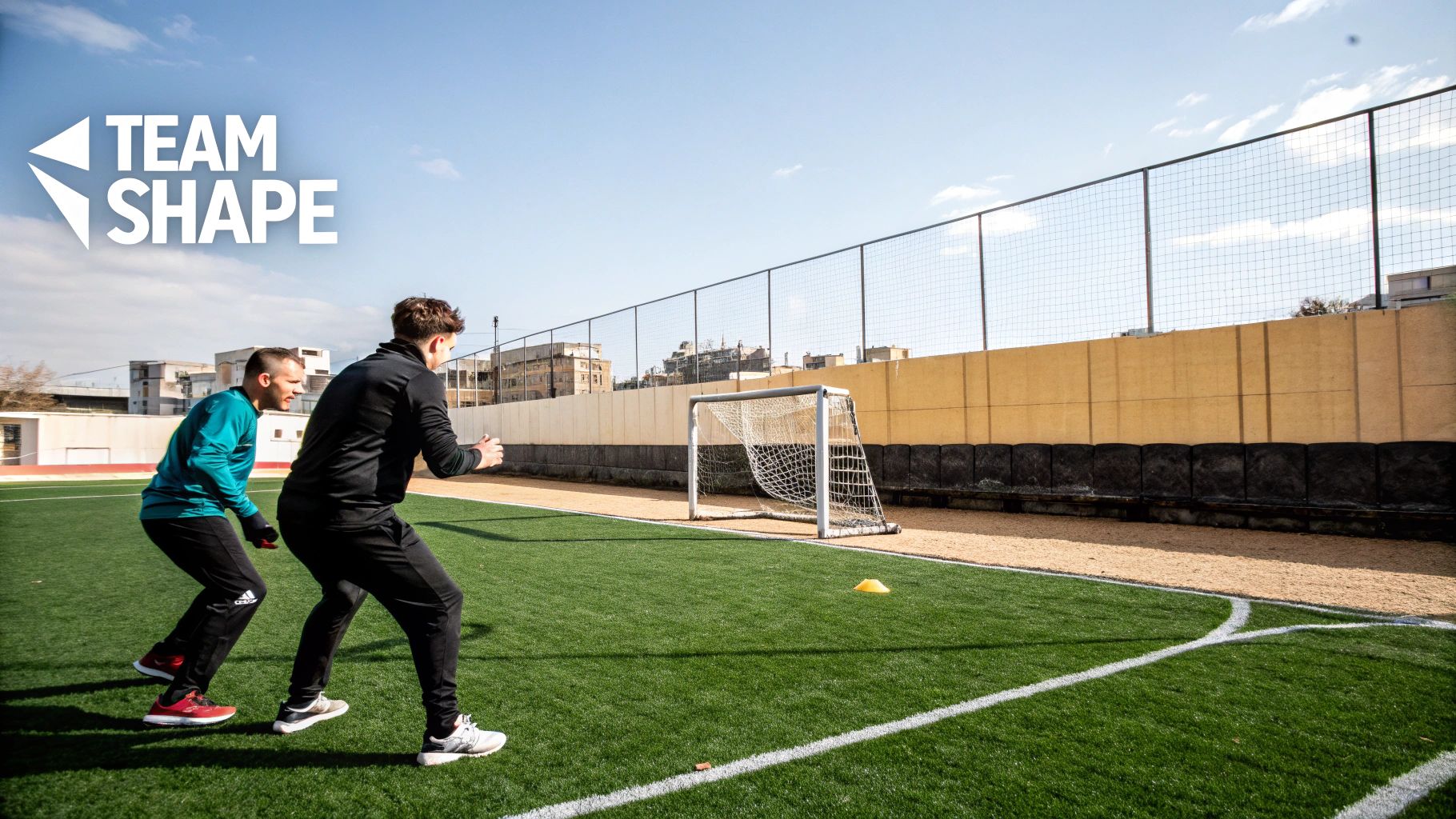
The 2v2 Duel: Communication and Cover
A defensive partnership always starts with a pair. The 2v2 drill strips everything back to this core relationship, focusing on the crucial dance between the first and second defenders—pressure and cover.
Getting it Set Up:
- Mark out a playing area roughly 20x25 yards with a full-size goal and keeper at one end.
- Two attackers start about 30 yards from goal, with two defenders positioned between them and the net.
- The drill kicks off when a pass is played into one of the attackers, who then try to combine and score.
The defenders’ objective is simple: stop the shot. This demands instant communication to decide who presses the ball carrier and who provides cover, protecting that dangerous space in behind.
The most common mistake I see in a 2v2 is both defenders getting sucked towards the ball. It’s an easy habit to fall into, but it leaves a simple pass to unlock the defence. This drill ruthlessly exposes that tendency and forces players to trust each other.
Essential Coaching Cues for 2v2s
To get the most out of this drill, your coaching needs to be laser-focused on the dialogue and decisions between the two defenders.
- Loud, Clear, and Early Communication: The first defender has to shout "I'm pressing!" or "My ball!" The covering defender must respond, letting their partner know they're in position. Silence is a killer here.
- The Right Distance and Angle: Your covering defender needs to be close enough to help but deep enough to see both the ball and the second attacker. Their body shape is key—it should allow them to either intercept a pass or step up if the first defender gets beaten.
- Passing the Runner: If attackers cross over, defenders have to communicate the switch. A simple, sharp call of "Switch!" or "Take him!" ensures the most dangerous player is always accounted for.
Upping the Ante with the 3v2 Overload
Defending is rarely a fair fight. Players constantly face overloads where attackers have a numbers advantage. The 3v2 drill is the perfect way to train decision-making and composure when outnumbered, mirroring a fast counter-attack.
The goal here isn't always about winning the ball back immediately. It's about delay. It's about staying compact, communicating, and forcing the attackers into a predictable, low-percentage shot from a bad angle.
Getting it Set Up: The setup is similar to the 2v2, but now you have three attackers against your two defenders. The attackers are encouraged to move the ball quickly to exploit their extra player.
Defenders have to work together to channel the play. They should try to keep the attackers in front of them, showing them wide and preventing any killer passes through the middle. Patience is everything; they need to wait for a heavy touch or a poor pass before making their move. This is less about tackling and more about smart, tactical shepherding.
A key part of coaching small-sided games is knowing which one to use and when. The right drill can target specific weaknesses and reinforce your team's defensive principles.
Choosing the Right Small-Sided Defensive Drill
| Drill (Players) | Primary Defensive Objective | Key Coaching Points | Recommended For |
|---|---|---|---|
| 2v2 | Pressure, cover, and communication | Body shape, vocal cues ("I go," "You drop"), angle of approach | Foundational practice for defensive pairings (CBs, FB/Winger) |
| 3v2 | Delaying the attack, staying compact | Forcing play wide, not diving in, protecting central areas | Training defenders to manage counter-attacks and overloads |
| 4v3 | Shifting as a unit, protecting the goal | Communication across the line, maintaining defensive shape | Working with a back three or a midfield/defence combination |
| 4v4 | Transitioning from attack to defence | Immediate pressure on the ball, recovery runs, regaining shape | All-purpose drill for building intensity and reaction speed |
Each drill serves a different purpose, from mastering basic partnerships in a 2v2 to handling chaotic transitions in a 4v4. Mix and match them based on what your team needs to work on that week.
The Pressure and Transition Game
Modern defending is aggressive and proactive. It's about winning the ball back the second you lose it. This drill is designed to mimic those chaotic moments after losing possession, training defenders to react instantly and hunt as a pack.
How it Works:
- Set up a 4v4 game in a tight area (around 30x40 yards) with small goals at each end.
- When a team scores or the ball goes out of play, the coach immediately serves a new ball to the other team, who launches a new attack.
- The team that just lost the ball must instantly switch from an attacking mindset to a defensive one, applying immediate pressure to win it back.
The whole point here is the speed of transition. There’s no time to feel sorry about a missed chance; the defensive mindset has to be switched on in a fraction of a second. This drill builds the aggressive, front-foot defending that defines top-tier teams. It's also a fantastic way to connect defensive principles with attacking ones, something we cover in our guide on possession drills for soccer.
To add another layer of realism and sharpen reaction times, try incorporating rebounders from SoccerWares into these drills. Placing one near the goal forces defenders to deal with unpredictable deflections and practise rapid clearances under pressure, simulating those chaotic scrambles that happen in the six-yard box. It's a simple piece of kit that can make a huge difference to a defender's reactions.
Your Blueprint for a Complete Defensive Session
Knowing a few good drills is one thing. Stringing them together into a high-energy, focused training session that actually improves your team? That's a different skill entirely.
This is my go-to 90-minute defensive blueprint. It’s designed to flow seamlessly from individual technique to team tactics, keeping players sharp and engaged from the first whistle to the last. While I've based it on an amateur adult or older teen team, you can easily tweak the timings and complexity for any group. The secret is to keep the intensity high, the coaching points sharp, and make sure every single activity builds on the last.
Phase 1: Dynamic Warm-up and Activation (15 Minutes)
Static stretching and a couple of sleepy laps around the pitch are a thing of the past. A modern warm-up needs to wake up the body and the brain, activating the exact movements and muscle groups players will be using for the next hour.
Think of it as a low-pressure rehearsal for defensive footwork.
- Movement Prep (10 mins): We'll start with dynamic movements to get the blood flowing—high knees, leg swings, hip openers. Then, we quickly progress into defensive actions within a 20-yard grid: side shuffles, jockeying backwards, and drop-steps to change direction.
- Ball Activation (5 mins): Get them in pairs, passing and moving. The key is to stay light on their feet, getting their touch dialled in while keeping that heart rate up.
The whole point here is quality of movement. Sloppy footwork now will only lead to bad habits when the pressure is on later.
Phase 2: Individual Skill Block (20 Minutes)
This is where we sharpen the tools. It’s all about getting in the reps needed to build that crucial muscle memory for winning 1v1 duels.
For this session, we're zeroing in on the Angle and Recovery Run Drill. It’s the perfect drill for hammering home the core principles of forcing an attacker wide and delaying their progress.
- Setup: Just as we described in section two, get your players into two lines, one for attackers and one for defenders.
- Execution: We'll run this for four sets of four minutes, with a solid one-minute rest in between each set. I constantly remind the defenders to be loud, talk to their keeper, and focus on their body shape to show the attacker exactly where I want them to go.
- Progression: Got a more advanced group? Add a second attacker making a looping run towards the back post. This forces the defender to solve two problems at once: deal with the ball carrier and scan for the secondary threat.
Phase 3: Tactical Block with SSGs (40 Minutes)
Time to put those individual skills to the test in a chaotic, game-like setting. This is where you see if the communication, decision-making, and team shape hold up under real pressure.
We’re going to run two different small-sided games (SSGs) to challenge different parts of their defensive brain.
- 3v2 Overload Game (20 mins): A classic for a reason. This game is brilliant for teaching a defensive pair how to manage being outnumbered. The focus is all on staying compact, communicating non-stop, and delaying the attack until help arrives. Run this for five rounds of three minutes, using the one-minute breaks for quick coaching feedback.
- 4v4 Pressure and Transition Game (20 mins): Now we ramp it up. This game is about what happens the instant the ball is lost. That split-second switch from attack to defence is a non-negotiable habit for any good team.
A quick tip for the transition game: as the coach, your job is to create that urgency. Be ready to serve a new ball in quickly and loudly the moment a play dies. This is how you train players to react instinctively, not just when they’re ready.
Through this whole phase, performance and decision-making will drop off a cliff if players get dehydrated. Having water readily available is a must. For a pro touch, consider kitting your squad out with team-branded water bottles from SoccerWares to keep everyone organised and hydrated.
Phase 4: Cool-down and Recovery (15 Minutes)
The session doesn't end when you stop the last game. A proper cool-down is non-negotiable; it helps reduce muscle soreness and gives the body a head start on recovery.
- Light Jog & Dynamic Stretches (5 mins): A slow team jog around the pitch brings the heart rate down gradually. Follow it up with some gentle, controlled dynamic stretches.
- Static Stretching (10 mins): Now it’s time to hold some stretches, focusing on the major muscle groups you’ve just hammered: hamstrings, quads, glutes, and calves. Make sure they hold each stretch for at least 30 seconds.
This is just as important as the warm-up. Don't skip it.
Adapting Your Defensive Session for Any Team
A great coach knows that one size never fits all. The session plan above is a fantastic template, but true coaching comes from knowing how to adjust it for your specific group's age, ability, and even their attention span. Here’s a quick guide on how you can modify the session.
Adapting Your Defensive Session for Any Team
| Player Level | Session Duration | Drill Complexity | Key Coaching Focus |
|---|---|---|---|
| Youth (U8-U12) | 60-75 Minutes | Low. Focus on fun, 1v1 game-based drills. | Body shape, basic jockeying, and making it fun. |
| Teen (U13-U18) | 90 Minutes | Medium. Introduce 2v2 and 3v2 overload concepts. | Communication, cover/balance principles, transition speed. |
| Adult (Amateur) | 90-100 Minutes | High. Use complex 4v4s and phase-of-play scenarios. | Tactical decisions, compactness, and high-intensity pressing triggers. |
Ultimately, the best session is one that challenges your players appropriately while keeping them engaged and learning. Use this blueprint as your starting point, but don't be afraid to make it your own based on what your team needs on any given day.
Essential Gear to Elevate Your Defensive Training
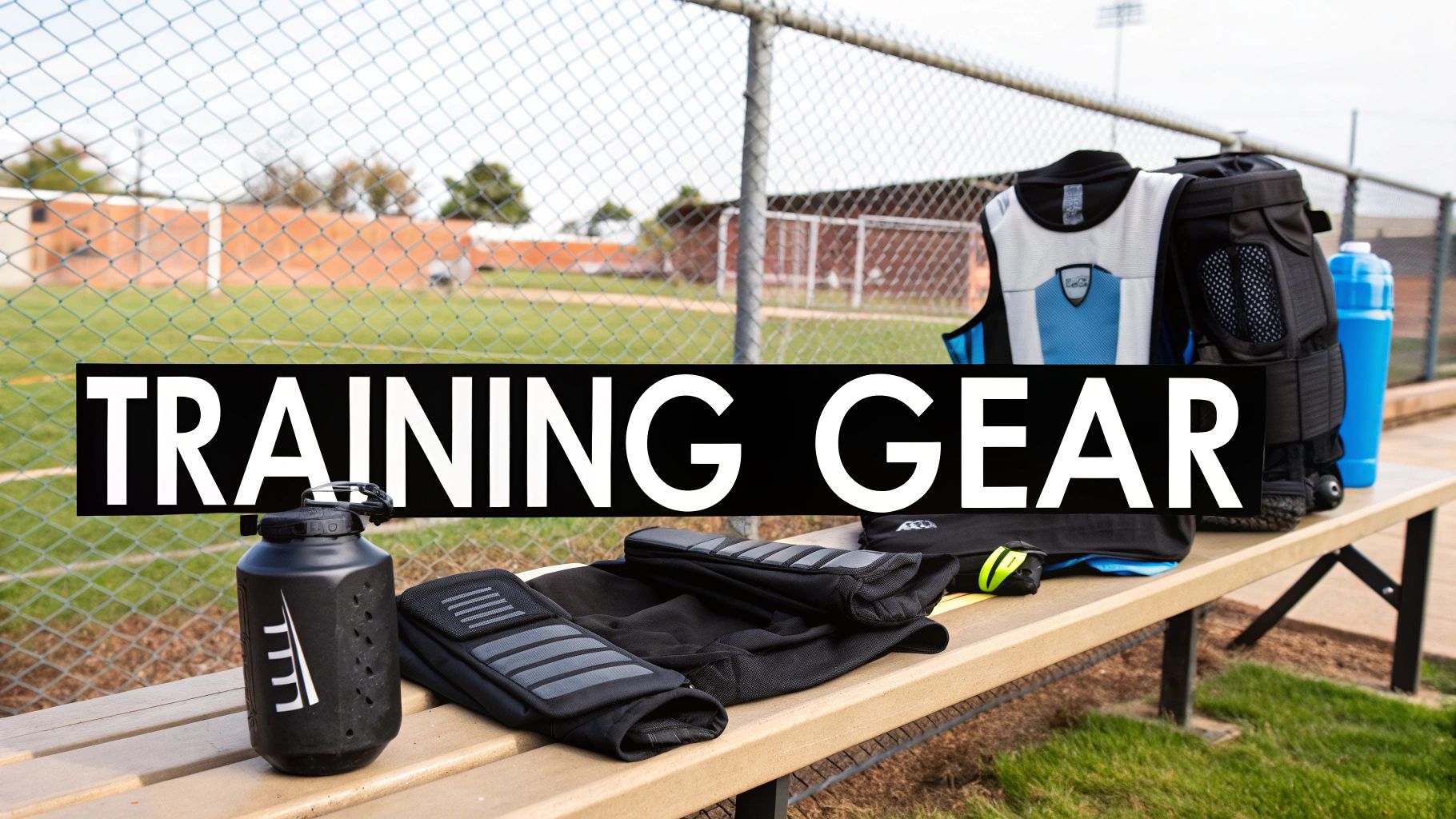
Having the right equipment doesn't just make a soccer defence drill easier to run; it makes it more effective. Quality gear can transform a basic practice into a focused, high-intensity session where players can really sharpen their skills safely and efficiently.
When you invest in a few key items, you elevate your training from just going through the motions to properly simulating real match conditions. From tracking player movement to ensuring everyone’s safe during aggressive drills, the correct tools are fundamental to building a truly formidable defence.
Core Equipment for Every Defensive Session
To get the most out of the drills we’ve covered in this guide, there are a few bits of gear that are non-negotiable. They provide structure, safety, and the ability to replicate game-day scenarios, whether you're on a pristine pitch or in a local park.
- Durable Portable Goals: These are absolutely essential for setting up the small-sided games we've discussed. Using proper goals instead of cones gives defenders a realistic target to protect and forces attackers to shoot with genuine precision. It’s a small change that makes a massive difference in creating a game-like environment.
- Premium Shin Guards: In any 1v1 or small-group drill, tackles are going to happen. High-quality shin guards from SoccerWares are a must-have for protecting players from impact. This allows them to commit to challenges with confidence and seriously reduces the risk of injury during a competitive practice.
- Agility Cones and Markers: The bread and butter of any training session. They’re vital for marking out grids for drills like the 'Winterbottom Duel' or setting boundaries for small-sided games. Good organisation is key, and these ensure every soccer defence drill is laid out clearly.
Advanced Tools for Deeper Insights
Beyond the basics, modern tech now offers some incredible tools for analysing and improving defensive performance. This kind of gear gives you objective data that takes the guesswork out of coaching.
A GPS tracker from SoccerWares is a perfect example. It provides hard data on a defender’s work rate, their positioning, and how quickly they make recovery runs. This information is invaluable for spotting fatigue and making sure players are maintaining their tactical discipline throughout a session. You can see exactly if a defender's intensity drops off or if they're holding their position correctly under pressure.
To build the engine required for effective defending, exploring different types of portable fitness equipment can also give your players that extra edge.
Training with the right gear isn't just about looking professional; it’s about creating an environment of excellence and safety. When players feel secure and have clear objectives, their development accelerates significantly.
Finally, for fans who want to train with a bit of pride, SoccerWares offers a range of club-branded gear for supporters of Arsenal, Manchester United, Manchester City, and Liverpool. You can find everything from water bottles to apparel, letting you show your allegiance while you sharpen your skills.
Feel free to explore our complete collection of football training gear to find exactly what you need.
Got Questions About Defensive Drills? We’ve Got Answers
Even after a solid session on the training pitch, there are always a few questions that pop up about the finer points of defending. Getting these details right is what turns a decent backline into a truly formidable one.
Here are some of the most common questions from coaches and players, along with straightforward, expert answers.
How Often Should We Be Doing Defensive Drills?
Defensive instincts aren't built overnight. They come from repetition. You can't just treat defending as a special topic once a month; it has to be part of your team's DNA.
For most youth teams, dedicating 15-20 minutes of every single training session to a defensive principle works wonders. One day it’s 1v1s, the next it’s pressing triggers. For more advanced amateur or semi-pro sides, it’s often better to have one entire session a week dedicated to defensive shape, organisation, and transitions. The bottom line is consistency. That’s what builds the muscle memory defenders need when the pressure is on.
What’s the Single Most Important Skill for a Defender?
It's not the slide tackle that gets the crowd roaring. The most critical skill any defender can have is positioning. It’s the invisible work that separates the good from the great.
A defender who reads the game well can shut down an attack before it even starts, often without laying a foot on the attacker. Good positioning means understanding angles, keeping the right distance, and always knowing what’s happening in the space behind you. It’s the foundation of every other defensive action.
The best defenders make the game look simple. They aren't flying into last-ditch tackles because their positioning was so good in the first place that the attacker never had a real chance to begin with.
How Can I Make Defensive Drills More Fun for Kids?
Simple: turn everything into a game. Young players will switch off if you have them standing in static lines doing repetitive, non-competitive drills. You’ve got to tap into their natural desire to compete.
- Make it a Competition: Run small-sided games where defenders earn points for winning the ball back, forcing a bad pass, or blocking a shot.
- Create Scenarios: Frame drills with a bit of imagination. A classic I love is 'Jailbreak', where attackers have to dribble past a defender to 'escape' a coned-off area.
- Celebrate Defensive Wins: Go just as wild for a perfectly timed interception or a solid defensive block as you would for a goal. Positive reinforcement is massive.
- Use Good Gear: Let’s be honest, training is always more exciting with proper equipment. Setting up with bright cones and some quality portable goals from SoccerWares makes any drill feel more professional and engaging.
Can I Practise Defensive Drills on My Own?
Absolutely. While team drills are essential for organisation, you can sharpen your individual defensive skills all by yourself.
Set up cones to work on your footwork—shuffling, jockeying backwards, and quick changes of direction are perfect for solo work. A rebounder is also a fantastic investment for any aspiring defender. You can practise clearances, controlling unpredictable bounces, and reacting quickly, which perfectly simulates those chaotic moments in a real match. Grabbing a durable rebounder from SoccerWares can seriously level up your individual practice time.
At SoccerWares, we provide the high-quality gear you need to elevate every aspect of your game, from individual skill work to full-team tactical sessions. Equip yourself for excellence by visiting https://soccerwares.com to explore our full range of training essentials and fan apparel.