

Muddy mats do work, and a properly specified entrance system can prevent up to 80% of collected dirt from being carried indoors, but a single short mat won't deliver that result. Football entrances need adequate length, separate scraping and absorbent stages, and regular cleaning.
After a wet weekend fixture, the familiar trail starts before the boots reach the kitchen. Grass clippings fall from the studs, wet clay spreads across the threshold, and a few strides later the hallway or clubhouse floor has a pattern nobody planned to mop. The question is whether a muddy mat changes that outcome or just gives the mud somewhere else to sit.
The honest answer is conditional. A mat removes a substantial amount of soil and moisture when it forms part of a multi-stage entrance flooring system. A small decorative doormat, placed for one quick step, usually catches the biggest clumps and leaves fine grit, damp soles and dirty footprints behind.
For players bringing home boots, kit and training equipment, the same principle applies whether the entrance is a terraced house, changing room or amateur club. UK facilities guidance, including the approach associated with BS 7953, treats entrance matting as a controlled transition zone rather than a decorative accessory. That practical distinction matters just as much as choosing suitable football equipment, such as the boots discussed in this guide to the best boots for defenders.
The Reality of Post-Match Mud
A player walks through the door after a soaked match, takes one step on a small mat and carries on. The mat may collect a little water and a few grass fragments, but the boot hasn't had enough contact with the fibres to release packed soil from its tread. The result is a mat that looks busy and a floor that still needs cleaning.
That doesn't mean the mat has failed completely. It means the setup was asked to do a job it wasn't designed to do. UK evidence indicates that suitable indoor and outdoor matting can prevent up to 80% of collected dirt from being carried into a building when it is correctly positioned and specified, as explained by UK facilities guidance on why entrance matting matters. The figure describes potential system performance, not a guarantee for every household doormat.
Why the small doormat loses
Football mud is a heavier load than ordinary street dust. Deep studs hold soil in recesses, wet grass sticks to the sole, and a clay pitch can leave a dense layer that a soft absorbent surface can't remove. A short mat also allows people to step over it, cross it in a single stride or reach the clean floor before their boots have been properly wiped.
The most useful way to think about the entrance is as a contamination control point. You want to remove the bulk of the soil outdoors, loosen what remains during the transition, then dry the sole indoors. That approach protects flooring and prevents the absorbent layer from filling with mud before it has dealt with moisture.
Practical rule: If the mat only covers one footfall, it's a welcome mat. If it creates a deliberate route across the entrance, it starts to function as flooring protection.
What works in real homes and clubs
For a football household, the effective arrangement is usually an outdoor scraper followed by a washable indoor mat. A clubhouse may need a longer, fixed system with drainage and a canopy, while a home entrance can achieve the same basic sequence with modular mats placed securely across the doorway.
The same care principles apply to any high-traffic floor covering. For advice on managing repeated dirt, moisture and foot traffic beyond football entrances, these 2026 rug care tips provide useful additional context. The mat won't eliminate sweeping, vacuuming or mopping, but it can move much of the mess to a place where it's easier to remove.
How Multi-Stage Matting Systems Trap Dirt
A football boot doesn't become clean because it touches a mat. It becomes cleaner because different surfaces attack different parts of the problem. Rigid scraping elements break the bond between soil and sole, brush fibres reach into tread recesses, and absorbent fibres remove the water that would otherwise carry fine dirt indoors.
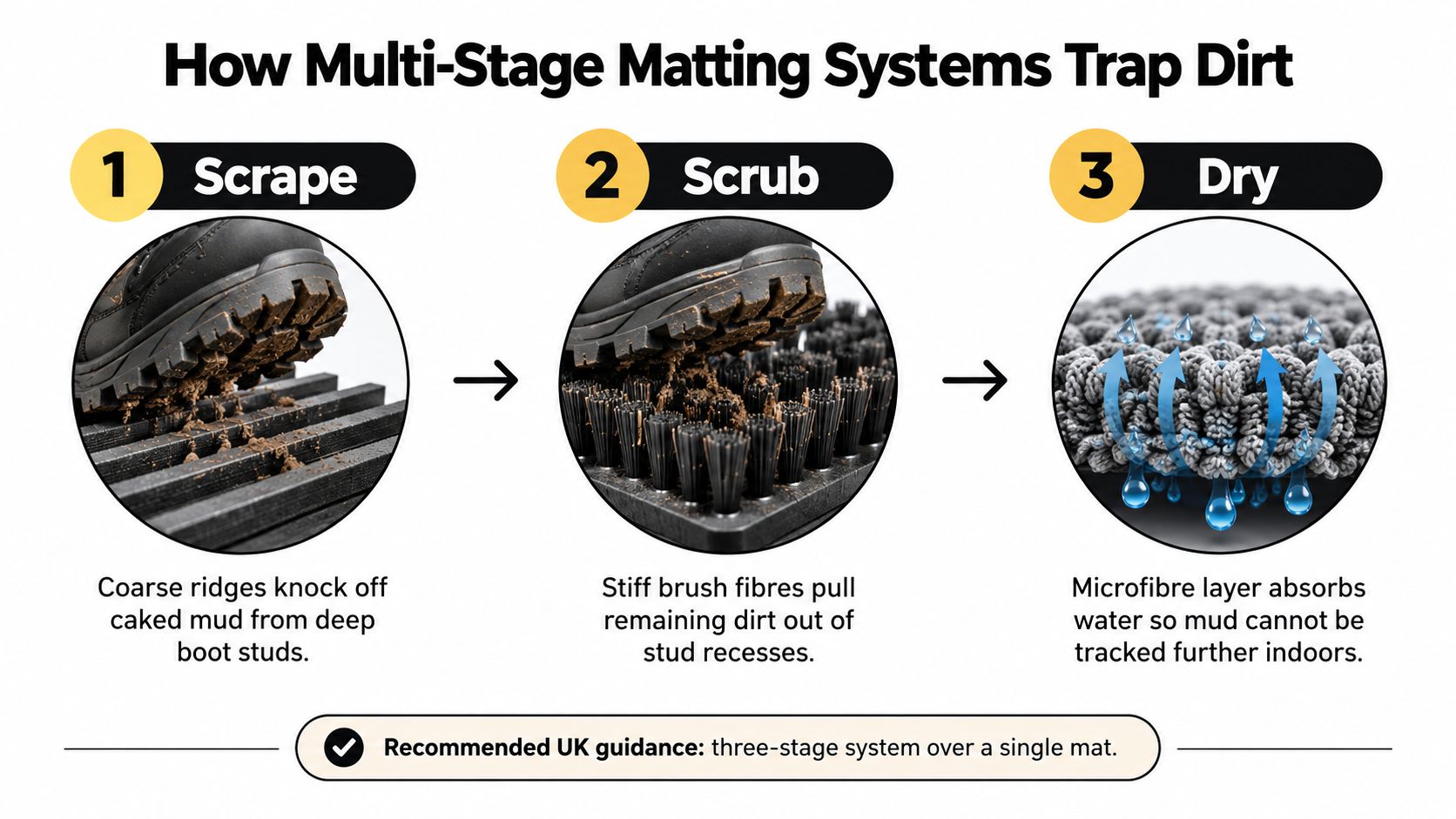
UK entrance-flooring practice built around BS 7953 uses the same broad logic. The system is designed to reduce the entry of soil and surface moisture through a sequence of surfaces, rather than expecting one material to scrape, brush and dry equally well.
Stage one removes the heavy load
The outside section should be the most aggressive. A scraper mat with coarse ridges or stiff elements breaks off caked mud, grass and loose grit while the user makes several deliberate passes. It should sit on a surface where released water can drain away, not on a smooth indoor floor where the first stage only redistributes the mess.
This is especially important after a grass match. If an absorbent mat is placed directly outside, it can become loaded with wet soil before it has a chance to absorb much water. Once its fibres are clogged, the player walks over a damp, dirty surface and carries the residue onwards.
Stage two works inside the tread
The intermediate section uses brush-like fibres to loosen finer particles. It reaches places a flat cloth-style doormat can't, including the spaces around moulded studs and the edges of small tread blocks.
Muddy mats work through a two-stage mechanical action, with coarse fibres dislodging soil and absorbent fibres retaining surface water and finer particles, as detailed in this guide to industrial matting and BS 7953 principles. In practical terms, the brush stage is the scrubbing action. It doesn't need to make the boot spotless, but it should remove the material most likely to become a footprint.
Stage three dries what remains
The final indoor mat should prioritise absorption and stability. Its job is to take residual moisture from the sole after the heavier dirt has been removed, while its backing keeps the mat flat and secure.
That ordering creates a useful division of labour:
- Scrape outside: Break away packed soil and grass.
- Scrub in transition: Pull finer grit from the tread.
- Dry indoors: Absorb water and remaining fine particles.
A setup using indoor training equipment should follow the same housekeeping logic. Players can keep equipment such as the options in this guide to indoor soccer training equipment away from the entrance, so wet boots and clean training surfaces don't contaminate one another.
Why Mat Length and Footfall Matter Most
The fastest way to test an entrance mat is to watch how people use it. If they step on it once and then reach the hallway, the mat hasn't had enough time to work. The meaningful unit isn't the mat itself. It's the number of controlled foot contacts across its scraping, brushing and drying surfaces.
BS 7953 describes the objective as reducing soil and surface moisture ingress to the lowest practicable level. That objective makes length important because repeated contacts give fibres more opportunities to interact with the sole. A short mat may still catch a large clump, but it can't provide the same cleaning route as a longer system.
The practical length guide
UK entrance-matting guidance cites minimum lengths of roughly 3 to 4 metres for low-traffic entrances, with the first 1.5 metres removing about 40% of dirt and moisture, according to guidance on how much entrance matting a building needs. Those figures describe building applications and shouldn't be treated as a guaranteed result for football mud, which can be heavier and stickier than everyday street contamination.
For higher-performance entrances, UK guidance commonly points towards a transition area equivalent to roughly 6 to 8 steps, or approximately 4 to 5 metres. Other entrance designs may need a longer route, depending on the surface materials, traffic and weather exposure. The point is consistent: one step isn't enough for reliable scraping and drying.
Measure the route, not just the doorway
Start by measuring the entrance width, then measure the available depth from the outside threshold to the clean internal floor. A mat that spans only half the doorway lets users bypass it, while a mat that ends before the natural walking line leaves the final steps untreated.
For a football household, prioritise:
- Full doorway coverage: Nobody should need to walk around the mat.
- Several deliberate steps: The route should encourage users to cross the full surface.
- Secure placement: The mat mustn't curl, slide or create a raised edge.
- Separate functions: Scraping and drying should happen on different surfaces where possible.
A changing room needs more capacity than a quiet home entrance, particularly when several players arrive at once. Yet the principle doesn't change. If the entrance can't provide enough length, add an outdoor boot scraper and ask players to clear the worst mud before they enter.
A large absorbent mat placed too close to the threshold can still underperform if users cross it in one stride. Depth only helps when the entrance layout makes people use it.
Handling Wet Clay and Artificial Turf Pellets
Not all football dirt behaves the same way. Wet grass mud can be fibrous and loose, clay can bond to studs like putty, and artificial-turf pellets can scatter as small, dry particles before becoming mixed with rainwater. A mat that performs well on one surface may struggle on another.
The difficult case is wet, clay-heavy soil. An absorbent mat may remove moisture from the outside of the boot while leaving the clay packed into the tread. The sole then looks drier but still releases dirt on the indoor floor. A mat designed mainly to absorb water may remove moisture without effectively scraping sticky clay or embedded gravel, which means scraping texture and pile depth can matter more than headline absorbency. The weather context behind this distinction is discussed in the Met Office account of autumn 2025 conditions.
Match the surface to the residue
| Pitch residue | Main problem | More suitable first response |
|---|---|---|
| Wet grass mud | Clumps, water and grass fibres | Ridged outdoor scraper |
| Clay-heavy mud | Sticky soil pressed into studs | Stiff scraper or boot brush before absorbent mat |
| Wet grit | Abrasive particles and moisture | Coarse scraper followed by a stable drying mat |
| Artificial-turf pellets | Loose granules that spread easily | Brush mat with regular emptying |
On a 3G surface, the issue may be less about a thick mud layer and more about small pellets mixed with water. A soft chenille-style surface can hold some moisture, but loose granules may sit on top or lodge in the pile. Brush fibres and frequent emptying usually make more sense than relying on absorbency alone.
That matters for the wider changing area too. Football clubs should combine entrance control with sensible turf sanitation best practices rather than treating the doorway as the only cleanliness measure.
Add a boot-cleaning point
A scraper mat can't remove a thick layer of clay from a deep stud pattern indefinitely. Put a boot scraper or stiff outdoor brush before the matting, ideally where released soil can be swept or washed away. Players should knock off heavy material outdoors, then use the scraper, brush and drying route.
The same weatherproof mindset applies to personal match gear. A lived-in Embroidered “Gunners 1886” Distressed Dad Hat is made from preshrunk cotton twill with a soft, unstructured crown, sewn eyelets and an adjustable hook-and-loop closure. It should be spot cleaned with warm water and mild dish soap, never soaked, then air dried, just as heavily soiled equipment needs a cleaning method suited to its material.
Maintenance Routines to Prevent Slip Hazards
A dirty mat eventually becomes a storage area for contamination rather than a control point. Soil blocks the fibres, moisture-holding capacity falls, and the next pair of boots meets a damp surface that can transfer residue straight back to the floor.
The safety issue is just as important as appearance. The HSE guidance on slips and trips in retail environments states that most slips happen on wet or dirty floors and advises that entrance mats should be non-slip, water-absorbent, kept in good condition and changed when saturated.
Use a routine that matches football traffic
A quiet entrance may need occasional attention, while a family with several players or a busy clubhouse needs checks around training and match times. Don't wait for visible puddles before taking action.
- Before use: Check that the mat lies flat, the backing grips the floor and the surrounding threshold is clear.
- After muddy sessions: Shake, brush or vacuum loose soil from scraper and brush sections before it dries into the fibres.
- During wet spells: Inspect the absorbent mat after each heavy use and move it somewhere ventilated if it remains saturated.
- During the season: Wash the mat according to its care instructions and make sure it dries fully before returning it to the entrance.
- When damaged: Replace mats with curled edges, failed backing or permanent saturation rather than adding another layer on top.
A saturated mat can be especially troublesome on a hard, non-breathable floor. It may stay wet, develop odour and return moisture to footwear or flooring. UK housing data reports that 31% of households reported an issue with condensation, damp or mould in 2024–25, although that figure doesn't establish that muddy mats cause indoor damp. It does reinforce the need to dry wet materials and ventilate enclosed entrances, as shown in the English Housing Survey findings on housing quality.
Keep the floor around it safe
A mat should never hide a wet patch beyond its edge. Wipe or mop released water, keep the doorway covered where possible, and make sure the backing doesn't creep across smooth tiles. Advice on choosing and managing non-slip outdoor tiles can also help clubs planning the approach to an entrance, particularly where rain reaches the threshold.
For players and parents, safe flooring belongs alongside safe training habits. Equipment covered in this injury prevention equipment guide can't compensate for a loose mat or wet floor, so inspect both before a busy session.
Building Your Ultimate Football Entrance Setup
The best entrance is not the one with the softest single mat. It's the one that gives dirty boots a clear route from heavy scraping to final drying, then gives the staff or household a realistic way to clean each stage.
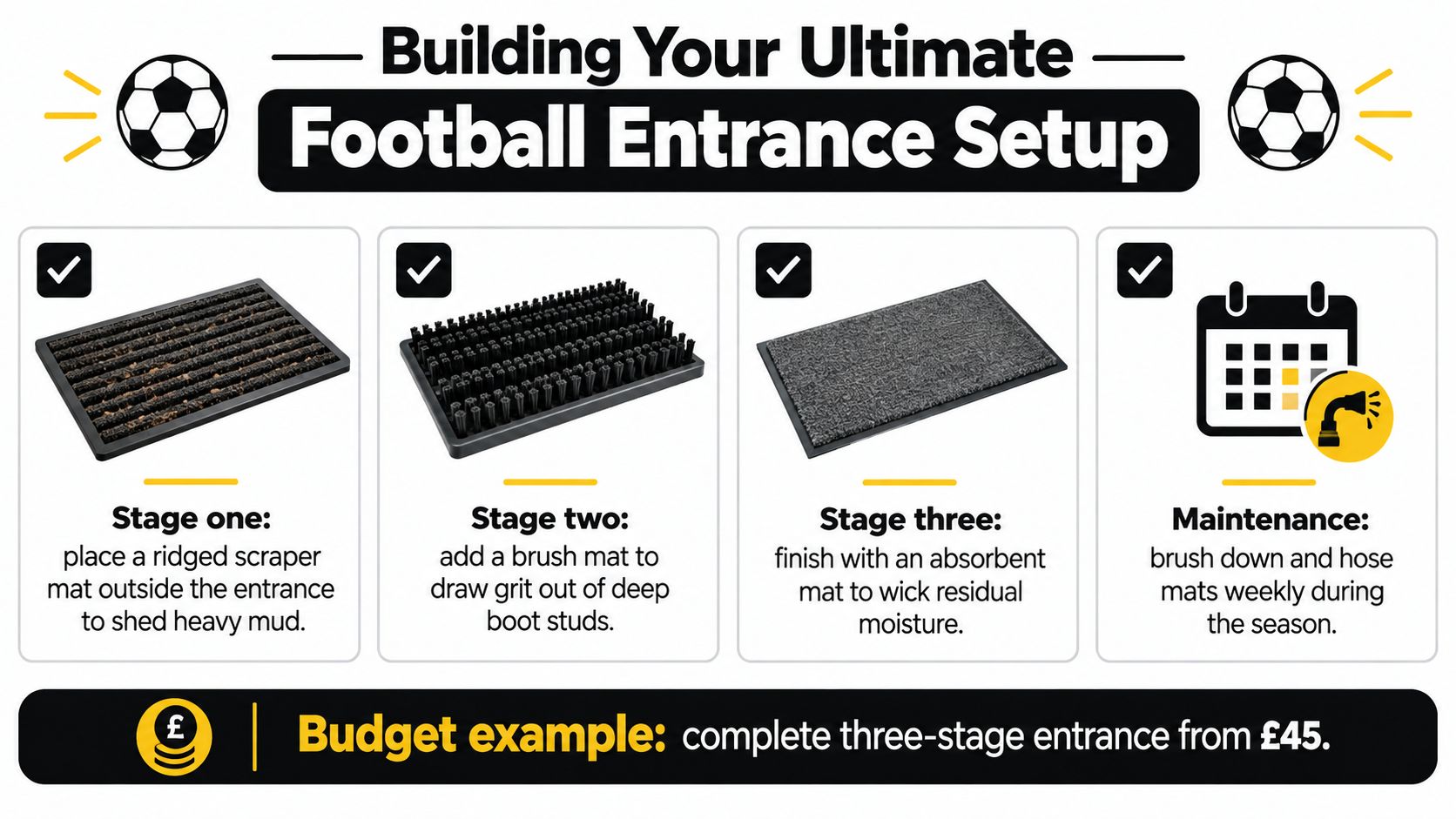
Build the setup in this order:
- Outside scraper: Choose a ridged, coarse surface that can shed clay, grass and grit before they reach the door.
- Transition brush: Add a stiff brush section where players can make several steps and work debris out of the stud pattern.
- Indoor drying mat: Finish with a washable, water-absorbent surface that stays flat and secure.
- Cleaning point: Keep a stiff brush, outdoor broom and suitable washing area close enough that maintenance doesn't become a chore nobody does.
For a home, the system may be modular mats arranged across a porch or utility-room entrance. For a club, it may be a fixed entrance with drainage, a canopy and a defined walking lane. The Livingston NHS Trust case reported by the HSE shows the value of this approach: a wet-weather entrance was redesigned with a 3-metre extension, an external canopy and three matting stages, with outdoor drainage followed by transition and indoor absorbent surfaces. The redesigned entrance was reported as very effective at removing water and contaminants from footwear on wet days, with only a few falls recorded over several years, according to the HSE entrance matting case studies.
Choose washable materials, measure the full route and replace anything that remains saturated or unstable. Keep clean training areas separate from the entrance, and use practical options such as portable training equipment where sessions need to move between indoor and outdoor spaces.
The answer to do muddy mats really work is yes, but only when the mat is treated as part of the entrance, not as a magic patch for a dirty boot. Scrape outside, brush through the transition, dry inside and maintain the whole route.
SoccerWares offers football merchandise and training essentials, including indoor training mats, rebounders, goals, shin guards and tracking equipment for players and supporters. Visit SoccerWares to organise the practical kit around your next session, then give muddy boots a proper entrance system before they reach the clubhouse floor.