

Proper football nutrition for energy is about strategically fuelling your body for the demands of the game. It means eating the right things—carbohydrates for fuel, protein for muscle repair—at the right times and staying hydrated to keep your stamina topped up. When you get this right, food becomes a serious competitive advantage, helping you play at your peak for the full 90 minutes.
Why Nutrition Is Your Secret Weapon on the Pitch
In modern football, talent and training will only take you so far. The real edge, the factor that separates the good from the great in the final minutes of a match, often comes down to how you fuel your body. Think of your diet as the ultimate support system for your physical skills; it directly impacts your stamina, speed, focus, and recovery.
Many amateur players grab whatever is convenient, treating their diet as an afterthought. Professionals, on the other hand, operate with a meticulously planned nutrition strategy where every meal and snack has a purpose. This guide is here to bridge that gap. We will show you how to turn everyday food into high-performance fuel, giving you the power to dominate when others are fading.
From Guesswork to Strategy
The first step is understanding what your body actually needs. The energy you burn in a light training session is completely different from what you will use in a high-stakes cup final. By tracking your on-pitch efforts with modern tools, you can get real data to tailor your diet for maximum impact. This is where smart nutrition meets technology.
A well-fuelled player is not just more energetic; they are mentally sharper, quicker to react, and less likely to pick up injuries. What you eat before, during, and after a match is just as critical as any tactical instruction from the coach.
This guide is packed with practical, evidence-based advice that will change how you prepare, play, and recover. Whether you are playing for a local Sunday league team or you have got semi-pro ambitions, these principles will help you build a powerful foundation. We will give you actionable steps to make sure your body is always primed for kick-off, turning your nutrition into your secret weapon.
The Three Pillars of a Footballer's Diet
To consistently perform at your best, you have to understand the fuel your body actually runs on. Think of it like a high-performance car; you would not put diesel in a petrol engine and expect it to work. The same logic applies to your nutrition.
The three core fuels, known as macronutrients, are carbohydrates, proteins, and fats. Each plays a distinct and vital role in powering you on the pitch. Mastering this balance is not about complicated diets or cutting things out; it is about making smart choices so your engine is always primed for explosive action and rapid recovery.
Let's break down what each one does and how you can use them to your advantage.
The diagram below shows exactly how nutrition forms the essential base that supports every other part of your performance.
It’s clear that while talent and skill sit at the top, they are built on a solid foundation where fuel is the fundamental starting block. Get that wrong, and the rest will eventually crumble.
Carbohydrates: The High-Octane Fuel
Carbohydrates are, without a doubt, the most important source of energy for a footballer. They are stored in your muscles and liver as glycogen, which is your body's readily available, high-octane fuel tank.
Every sprint, jump, tackle, and high-intensity run you make is powered primarily by these glycogen stores. When that tank runs low, you hit the wall. Your legs feel heavy, your decision-making slows, and your ability to make those crucial late-game runs disappears. A diet rich in carbohydrates is non-negotiable for any serious player.
But not all carbs are created equal. They fall into two main camps:
- Complex Carbohydrates: These are your slow-releasing energy sources, perfect for meals hours before a match or training. Think wholewheat pasta, brown rice, oats, and potatoes.
- Simple Carbohydrates: These give you a quick burst of energy, making them ideal for a pre-match snack or a half-time boost. Examples include bananas, energy gels, jelly babies, or a slice of white bread with jam.
The challenge is getting enough of the right type. For Premier League players, UK guidelines recommend 6-10g of carbohydrates per kg of body weight daily. Yet, a study on a top English club showed players only consumed an average of 3-5g/kg during competitive matches—far below the 6-8g/kg endorsed by UEFA for busy fixture periods.
The result? Depleted glycogen stores and a 15-20% drop in high-intensity running by the final whistle. That is the difference between winning and losing.
Protein: The Repair Crew
If carbs are the fuel, protein is the dedicated repair crew. Every training session and match causes microscopic tears in your muscle fibres. Protein provides the essential building blocks—amino acids—needed to repair this damage and rebuild your muscles stronger than before.
Consistent protein intake is crucial for recovery, building strength, and preventing injuries. Without enough of it, your body simply cannot keep up, leaving you fatigued and more susceptible to strains and pulls.
Your body is in a constant cycle of breakdown and repair. Supplying it with a steady stream of protein ensures the repair process always wins, leading to improved strength and resilience over the season.
Excellent UK-based sources of lean protein include:
- Chicken and turkey breast
- Lean red meat like beef or lamb
- Fish such as salmon, cod, or tuna
- Eggs and low-fat dairy like Greek yoghurt
- Plant-based options like lentils, chickpeas, and tofu
Fats: The Long-Haul Energy Tank
Fats often get a bad reputation, but they are a vital part of a footballer's diet. They act as a secondary, long-duration energy source, which is especially important during lower-intensity periods of a match, like jogging back into position. Think of them as the reserve fuel tank your body taps into when the high-octane carb energy is not needed.
More importantly, healthy fats are essential for absorbing vitamins and producing hormones that regulate everything from muscle growth to recovery. Ignoring fats means you’re compromising your overall health and your body's ability to function at its peak.
Focus on incorporating unsaturated fats from sources like:
- Avocados
- Nuts (almonds, walnuts) and seeds (chia, flax)
- Olive oil
- Oily fish like salmon and mackerel
For a deeper dive into making food choices that support prolonged vitality, check out these best foods for sustained energy.
Macronutrient Roles for Footballers
To bring it all together, here is a quick-reference table summarising the role of each macronutrient.
| Macronutrient | Primary Role in Football | Best UK Food Sources | Optimal Timing |
|---|---|---|---|
| Carbohydrates | Main source of high-intensity fuel (glycogen) | Oats, wholewheat pasta, brown rice, potatoes, bananas, sports drinks, jelly babies | Complex carbs 3-4 hours before; Simple carbs 30-60 mins before, at half-time, and immediately after |
| Protein | Muscle repair, recovery, and growth | Chicken, turkey, lean beef, salmon, eggs, Greek yoghurt, lentils, tofu | Consumed with every meal, especially within 2 hours post-training or match |
| Fats | Secondary, low-intensity energy source; hormone production and vitamin absorption | Avocados, nuts, seeds, olive oil, oily fish (salmon, mackerel) | Throughout the day with meals, but limit intake in the immediate pre-match meal to aid digestion |
By understanding and balancing these three pillars, you can build a powerful nutritional foundation that fuels elite performance and keeps you on the pitch week after week.
Your Match Day Nutrition Timeline
Winning on the pitch does not start at kick-off; it begins hours earlier in the kitchen. A well-timed nutrition plan is the difference between having explosive energy in the first minute and still having gas in the tank for the final whistle. The goal is to ditch the guesswork and follow a clear blueprint for what to eat and when.
This timeline is your chronological guide to fuelling for peak performance, covering everything from your main pre-match meal right through to the crucial recovery phase afterwards. Once you understand the why behind each stage, you can make sure your muscles are fully stocked, primed for action, and ready to repair efficiently.
Let us break down the perfect match day schedule.
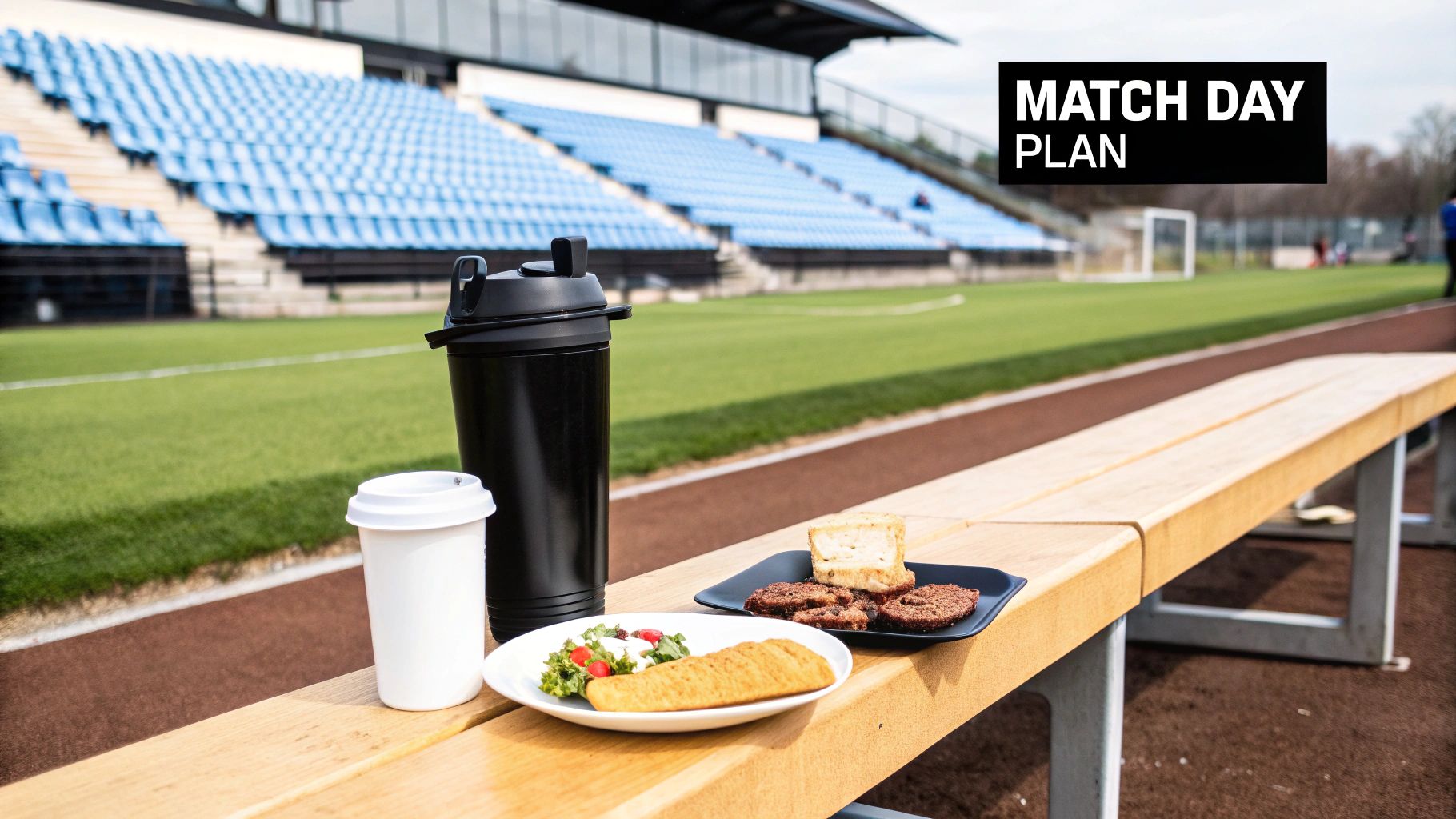
The Pre-Match Meal (3-4 Hours Before Kick-Off)
This is your main fuelling event. Eaten 3-4 hours before the match, this meal has one job: to top up your muscle glycogen stores to their absolute maximum. Think of it as filling the main fuel tank of a high-performance engine.
The meal should be loaded with complex carbohydrates for slow-releasing, sustained energy. It also needs a moderate amount of lean protein to support muscle function and keep hunger at bay. Critically, it needs to be low in fat and fibre to avoid any digestive trouble that could slow you down on the pitch.
Solid pre-match meal ideas include:
- A bowl of porridge with sliced banana and a drizzle of honey.
- Grilled chicken breast with a large portion of sweet potato and a side of broccoli.
- A wholewheat pasta dish with a simple tomato-based sauce and some lean mince.
Eating this far out gives your body plenty of time to digest the food and turn it into accessible energy. Never try a new food for the first time before a big game; stick to what you know your body handles well. For parents trying to get this right for young players, our matchday checklist for football parents is a massive help.
The Final Top-Up (60-90 Minutes Before Kick-Off)
With about an hour to go, your main meal is digested, and it is time for a final, quick energy hit. This is not another meal but a small, strategic snack designed to give your blood sugar a little lift and ensure your glycogen stores are completely full.
This snack should be all about simple, easily digestible carbohydrates. Now is not the time for anything heavy, fatty, or fibrous. You want energy that gets into your system fast without sitting in your stomach.
The purpose of this final snack is to fine-tune your energy levels, ensuring you start the match with maximum power from the very first whistle. It’s the final piece of your pre-game fuelling puzzle.
Excellent options for this final top-up are:
- A ripe banana.
- A small handful of dried fruit, like dates or raisins.
- A slice of white toast with jam.
- A sports-specific energy gel or some chews.
This little snack stops you from dipping into precious muscle glycogen stores during the warm-up, saving them for when the game actually kicks off.
Half-Time Refuelling (During the Match)
The first half burns through a huge chunk of your energy reserves. That 15-minute half-time break is a non-negotiable window to refuel for a strong second-half performance. The objective here is simple: rapid energy replenishment.
You need to get 25-50 grams of simple carbohydrates in that can be absorbed quickly. Fluids are just as important to fight off dehydration, which is a major cause of fatigue and cramping.
Smart half-time options are:
- An isotonic sports drink (provides carbs and electrolytes).
- A few jelly babies or similar high-sugar sweets.
- Half a banana or an energy gel.
This quick intake can make a massive difference to your stamina and sharpness in the last 30 minutes, helping you stay intense when opponents are starting to fade.
The Post-Match Recovery Window (Within 30-60 Minutes After)
The final whistle does not mean your nutrition plan is over. The 30-60 minutes right after a match are often called the "golden window" for recovery. In this period, your muscles are like sponges, primed to soak up nutrients and start the repair process.
To kickstart recovery, you need a mix of carbohydrates and protein. The carbs get to work refilling the glycogen you have just burned, while the protein supplies the amino acids needed to repair the microscopic muscle damage caused by all that sprinting and tackling. Aim for a 3:1 ratio of carbohydrates to protein.
A recovery shake is often the easiest and most effective option. Using a simple SoccerWares shaker bottle, you can mix a drink in seconds and have it on the way home, making sure you never miss that critical window.
Other great recovery options include:
- A pint of chocolate milk.
- A protein bar paired with a piece of fruit.
- A pot of Greek yoghurt with berries.
Following this timeline turns match day nutrition from a guessing game into a real strategic advantage. It gives you the sustained energy needed to perform at your peak for the full 90 minutes and beyond.
How Hydration Dictates Your Stamina
If carbohydrates are the fuel, think of hydration as the engine coolant that keeps your entire system from overheating. It is an easy part of football nutrition to overlook, yet it is arguably one of the most critical. Lose just 2% of your body's water through sweat, and you will feel your performance nosedive.
This is not just about feeling a bit thirsty. When you are dehydrated, your blood literally thickens. This forces your heart to work overtime just to pump it around your body to your working muscles. The result? You get tired faster, your sprint speed drops, your passing accuracy goes out the window, and your on-pitch decision-making becomes clouded.

A proper hydration strategy is not something you can just wing on match day. It is a 24/7 commitment that starts long before you step onto the pitch and continues well after the final whistle.
The Three Phases of Smart Hydration
The key is to think about hydration in three distinct phases: before, during, and after you play. Each one has a specific goal, and if you get them all right, you will stay sharp, strong, and cramp-free.
-
Pre-Hydration (The Day Before & Morning Of): The aim here is simple: start the match or training session fully topped up. You cannot achieve this by chugging a litre of water an hour before kick-off. Instead, drink fluids consistently the day before, then have around 500ml of water 2-3 hours before the game starts.
-
During-Activity Hydration (Training & Match): Now your job is to replace what you are losing through sweat to stop dehydration from creeping in. It is not uncommon for players to lose 1-3 litres of sweat during a 90-minute match. Try to drink 150-250ml every 15-20 minutes, grabbing every chance you get during breaks in play and especially at half-time.
-
Post-Activity Rehydration (Recovery): After the final whistle, it is all about replenishing the fluid you lost to kickstart your recovery. A good rule of thumb is for every kilogram of body weight you have lost, you need to drink approximately 1.5 litres of fluid over the next few hours.
When Water Is Not Enough: Electrolytes
During an intense game, especially on a warm day, you lose more than just water in your sweat. You are also losing crucial minerals called electrolytes—things like sodium, potassium, and magnesium. These are absolutely vital for making your muscles work properly and for nerve signalling.
An imbalance in electrolytes is one of the biggest culprits behind muscle cramping. If your calves start seizing up in the last 20 minutes of a match, it’s a massive red flag that water alone is not cutting it.
This is where sports drinks have a role to play. For any session lasting over 60-90 minutes, an isotonic sports drink is often a better bet than plain water. It hits three birds with one stone:
- Fluids for hydration.
- Carbohydrates for a quick energy top-up.
- Electrolytes to replace what you have sweated out and help prevent cramp.
Making Hydration a Habit
Honestly, the easiest way to fail at hydration is to be unprepared. One of the simplest but most powerful tools you can have is a durable, reusable water bottle. Keeping one in your kit bag at all times makes it easy to measure your intake and sip consistently. It turns hydration from something you forget about into a professional habit.
For a deeper dive, our complete guide on football hydration tips offers more actionable advice to keep you at the top of your game. By making fluid intake a priority, you are directly investing in your stamina and performance on the pitch.
Fuelling for Training and Recovery Days
Peak performance is forged on the training ground, not just polished on match day. The intense physical demands of football demand a nutrition strategy that adapts to your daily workload. One of the most common mistakes players make is treating every day like a match day—instead, the smart approach is to 'fuel for the work required'.
This means your football nutrition for energy plan has to be flexible. On days you are running high-intensity drills, sprints, and small-sided games, you need more fuel—specifically, more carbohydrates. But on lighter days or complete rest days, your body's needs shift, focusing more on repair and nutrient replenishment.
Mastering this balance is the key. It ensures you have the energy to smash every session without consuming excess calories that could lead to unwanted weight gain. It is all about being strategic and listening to what your body needs each day.
Adjusting Your Fuel for Training Intensity
Think of your body's energy stores like a mobile phone battery. A heavy training day drains it almost completely, while a light session might only use a fraction of its power. You would not charge your phone to 100% if it is already at 80%, and the same logic applies to your carbohydrate intake.
-
High-Intensity Training Days: On these days, your meals should look a lot like your match day plan. Focus on upping your carbohydrate intake to fuel those explosive movements and maintain stamina right through the session. Good choices include larger portions of pasta, rice, or potatoes with your main meals.
-
Light/Technical Training Days: When the session is more about skill, tactics, or set pieces with less running, you can dial back your carbohydrate portions slightly. Fill that space on your plate with extra vegetables or a larger portion of lean protein to support recovery without over-fuelling.
-
Recovery/Rest Days: These days are all about repair. Your carbohydrate needs are at their lowest, but your protein and micronutrient intake should be high. Prioritise lean protein sources, colourful vegetables, and healthy fats to help your muscles rebuild and reduce inflammation. This intelligent approach is also fundamental to how you build stamina for football over the long haul.
The Constant Need for Your Repair Crew: Protein
While your carb intake will go up and down, your protein intake needs to stay consistently high, every single day. Training triggers muscle breakdown, and protein provides the essential building blocks—the amino acids—needed for repair and growth. Spreading your protein intake evenly across the day, in every meal and snack, creates a constant supply for this vital process.
This steady stream of protein ensures your body is always in a state of repair, helping you recover faster, build strength, and lower your risk of injury. In UK football, elite pros need 1.6-2.2g of protein per kg of body weight daily just to repair the micro-tears from running 10-12km a match. Worryingly, 2023 research from English academies found that 68% of youth players fell short, consuming just 1.4g/kg. This led to 18% slower recovery times and more second-half fatigue.
Practical Meal Ideas for Busy Players
Sticking to a nutrition plan can feel like a chore when you are juggling training, work, or studies. The key is to keep it simple and plan ahead.
“Failing to plan is planning to fail. Your daily nutrition is the foundation upon which your on-pitch improvements are built. Consistency beats intensity every time.”
Here are some simple, effective meal and snack ideas to get you started:
- Breakfast: Porridge with berries and a scoop of protein powder.
- Lunch: A large chicken salad wrap on a high-intensity day, or a salmon and avocado salad on a recovery day.
- Dinner: Lean beef bolognese with wholewheat pasta after a tough session, or grilled fish with roasted vegetables on a lighter day.
- Snacks: Greek yoghurt, a handful of nuts, or a piece of fruit.
For even more ideas on refuelling after tough sessions, check out these smart after-game snack ideas for youth sports athletes. This daily consistency is what truly powers long-term energy and improvement.
Building Your Personalised Nutrition Plan
All this theory is great, but turning it into what you actually put on your plate is where the real advantage is won. Getting your football nutrition for energy right is not about starting some rigid, complicated diet. It is much simpler than that. It is about making consistently smart choices that give you a genuine edge over your opponents.
You now understand the core principles. Carbohydrates are your high-octane fuel for sprints and stamina, protein is your essential repair crew for battered muscles, and hydration is the master switch for your focus and physical output. Think of these as the levers you can pull to directly influence how you play.
From Knowledge to Action
The key is weaving these lessons into your daily routine, starting small and building habits that actually stick. Do not try to overhaul everything overnight—that is a recipe for failure.
- Start with one meal: Just focus on perfecting your pre-match meal first. Nail that, then move on.
- Prioritise hydration: Get a good water bottle and carry it with you everywhere. Simple, but effective.
- Plan your recovery: Do not leave it to chance. Have a protein-and-carb snack ready in your kit bag for straight after every session.
This gradual approach makes the change feel manageable and, more importantly, makes it last.
True peak performance is not achieved through the odd 'perfect' meal. It comes from the cumulative effect of consistently good nutritional habits, day in and day out.
This knowledge gives you control over a massive factor in your football development. Combine a smart nutrition strategy with a structured training schedule, and you have a powerful formula for success. For guidance on the physical side of things, our football preseason training plan provides an excellent blueprint to follow.
Ultimately, fuelling your body correctly is a direct investment in your performance. By applying these principles, you are not just eating better; you are actively training to become a stronger, faster, and more resilient player on the pitch.
Got Questions? We've Got Answers
Figuring out football nutrition can feel a bit overwhelming, especially when you are trying to cut through the noise and find what actually works. Here are some of the most common questions we get from players, parents, and coaches.
What Are the Best Pre-Match Snacks for a Quick Energy Boost?
You will want to grab a snack about 60-90 minutes before your warm-up starts. The goal here is simple: top up your energy stores with easily digestible carbohydrates without causing any stomach trouble when the whistle blows.
Stay away from anything high in fat, fibre, or too much protein right before a game. These slow down digestion and can leave you feeling heavy and sluggish on the pitch.
Some brilliant, no-fuss options are:
- A ripe banana (the classic for a reason!)
- A few dates or a small handful of raisins
- A slice of toast with a bit of jam or honey
- A simple, low-fibre cereal bar
- A sports energy gel or chew if you are used to them
Do Youth Footballers Need Supplements Like Protein Shakes?
For almost all youth players, the answer is no. A balanced diet packed with real, whole foods gives them all the protein they need for muscle repair and healthy growth. We always stand by a ‘food first’ approach—it’s the safest and most effective way for young athletes to get their nutrition.
That said, for older teens with a really tough training and match schedule, a protein shake can be a useful tool. It is a convenient way to kick-start recovery right after a hard session, especially if a proper meal is still an hour or more away.
Before any young player starts taking supplements, it’s vital to have a chat with a parent, coach, or a qualified nutritionist. They can help you figure out if it is genuinely needed for their situation.
How Much Water Should I Drink on Match Day?
Great hydration for a match is not something you can cram in an hour before kick-off. It is a process that starts the day before. The trick is to sip little and often, not chug massive amounts all at once.
Try following this simple timeline:
- The Day Before: Make sure you are drinking water consistently all day. You want to start match day already hydrated.
- 2-3 Hours Before Kick-Off: Drink around 500ml of water. This gives your body time to absorb what it needs and get rid of any excess.
- 1 Hour Before Kick-Off: Sip on another 200-300ml in that final hour.
- During the Match: Take advantage of breaks in play and half-time. Aim for 150-250ml every 15-20 minutes.
Want a quick hydration check? Take a look at your urine colour. A pale, straw-like yellow means you are good to go.
At SoccerWares, we know that what you do off the pitch is just as important as what you do on it. Peak performance comes from smart training and even smarter preparation. Get the gear that backs up your hard work, from training essentials to recovery tools. Check out our full collection at https://soccerwares.com and find what you need to elevate your game.