

When you see a player dart past a defender with a sudden burst of speed or change direction on a sixpence, you're not just watching raw talent. You're seeing the result of countless hours spent mastering the fundamentals, and one of the simplest, yet most effective, tools for this is the humble football ladder.
Often called an agility ladder, this piece of equipment is specifically designed to sharpen a player's Agility, Balance, and Coordination (ABCs). Nailing these fundamentals is the foundation for everything that happens on the pitch.
The Secret Weapon in Modern Football Training
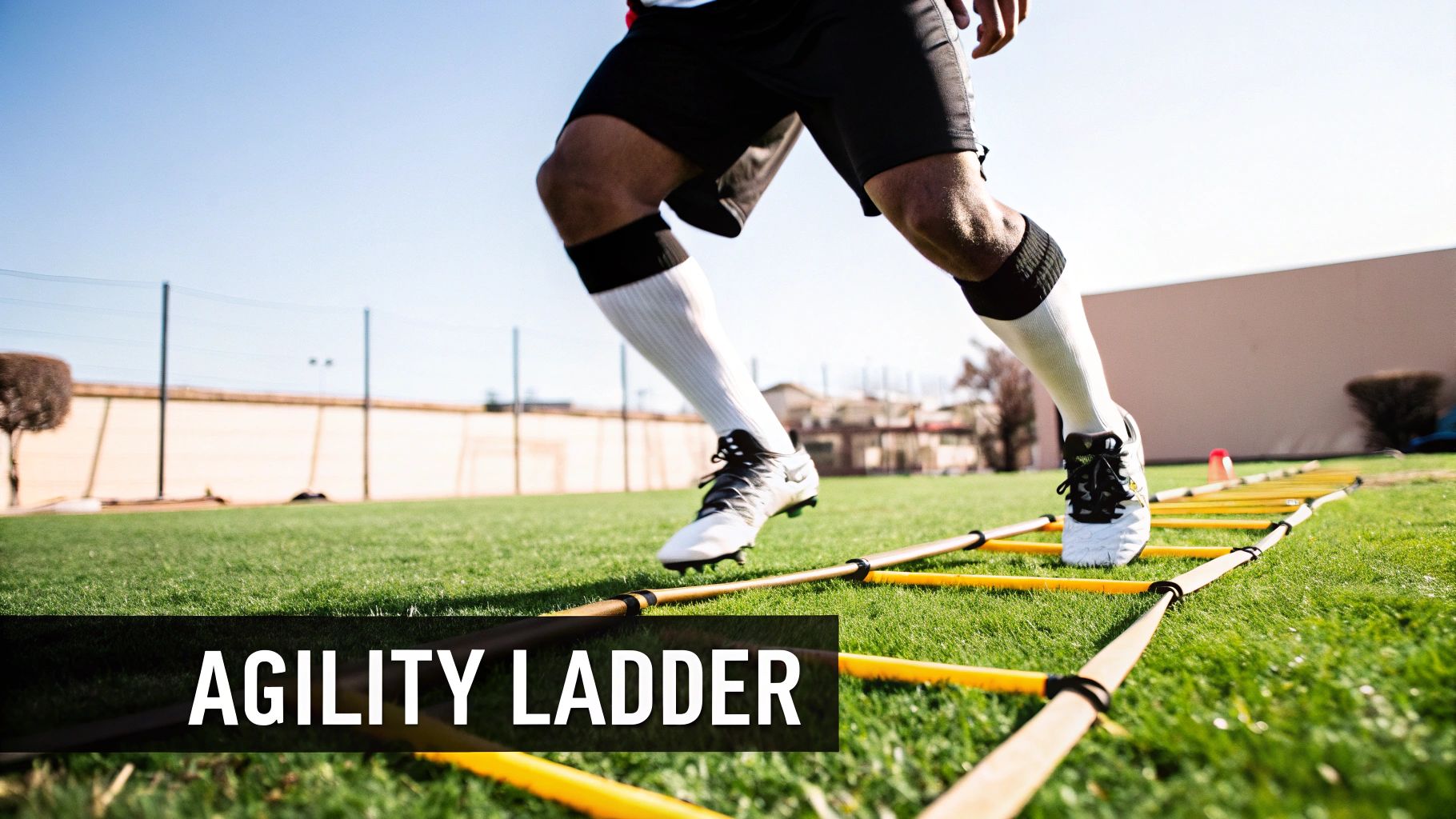
At first glance, it's just a few plastic rungs on some webbing. But don't be fooled. Think of it like a guitarist running through scales before a big solo. The repetitive, precise movements demanded by ladder drills build crucial neural pathways and hardwire muscle memory.
This is what allows players to pull off complex, split-second movements almost without thinking during a match. It’s the secret behind a winger’s explosive change of pace or a defender's ability to pivot instantly and stick in a perfectly timed tackle.
Mastering the ABCs of Athleticism
The real power of a football ladder comes down to those three pillars of athleticism:
- Agility: The ability to accelerate, decelerate, and change direction in a heartbeat, all while staying in complete control.
- Balance: The skill to maintain a stable centre of gravity, especially when challenged by an opponent or stretching for a loose ball.
- Coordination: Making different parts of your body work together smoothly and efficiently, turning clumsy movements into fluid, powerful actions.
Master these, and a player doesn't just get better—they get safer. Sharper neuromuscular connections mean improved body control, which goes a long way in preventing the common sprains and strains that result from sharp, sudden movements in a game.
The real magic of the agility ladder isn't just in making your feet faster; it's in synchronising your mind and body to react instantly and efficiently to the unpredictable flow of the game.
From academy youngsters learning the basics to Premier League stars maintaining their edge, the agility ladder is a cornerstone of modern training. It's an affordable, high-impact tool that belongs in every player's development plan. For a complete look at other essential kit, you can explore the full range of football training equipment at SoccerWares.com.
The Science of Faster Feet and Sharper Reactions
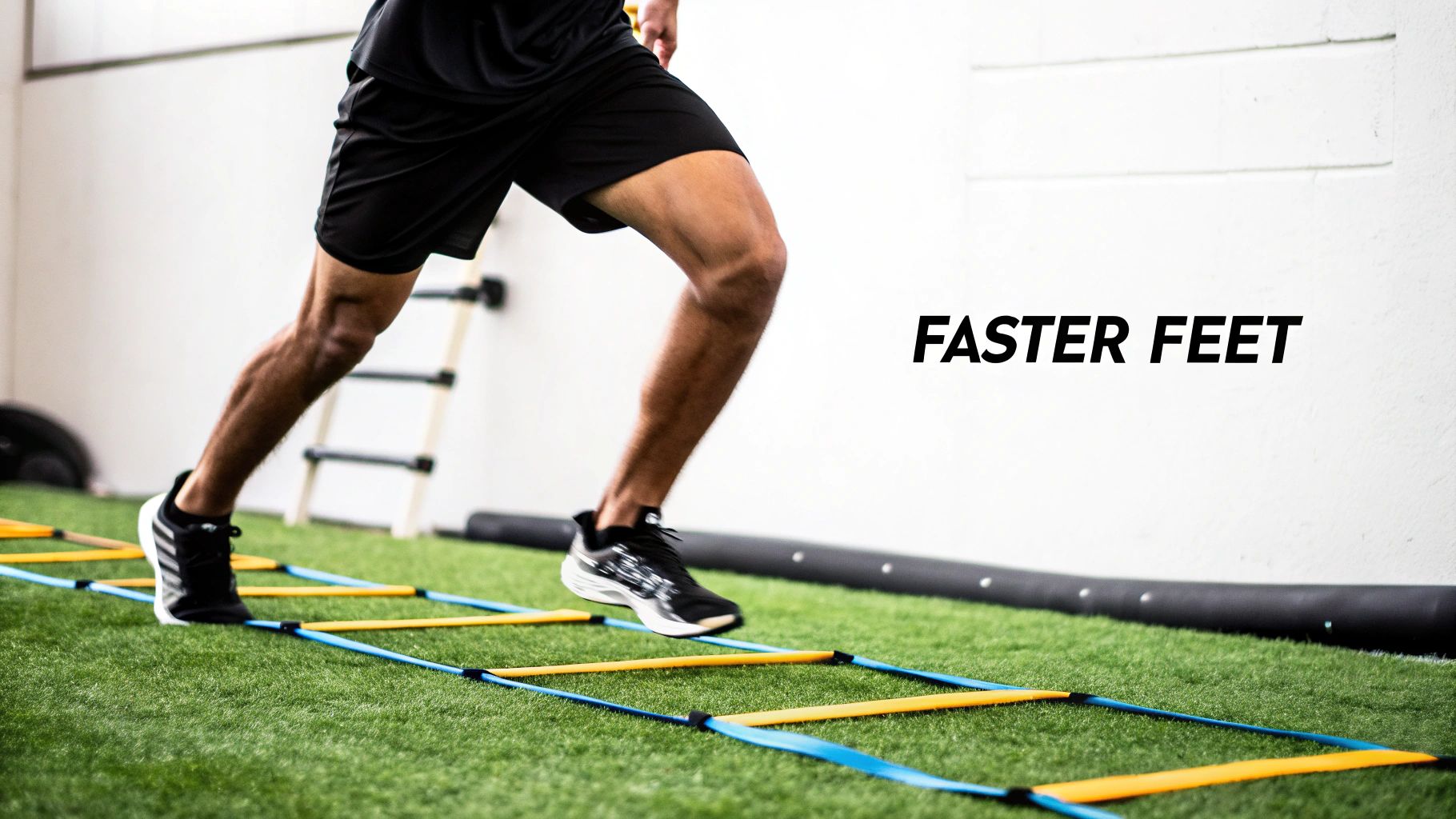
When you see a top player execute a sudden turn or a rapid step-over, it's not just about raw muscle power. It’s about a lightning-fast conversation happening between their brain and their feet. This is exactly where ladders for football training come into their own.
The quick, repetitive drills are designed to supercharge your neuromuscular system, making that vital brain-to-body connection faster and more automatic.
Think of it as upgrading your body’s internal wiring. Every time you run through a ladder drill, you're strengthening the neural pathways that instruct your feet on how to move with precision and speed. Over time, these movements become second nature, allowing you to react on the pitch without conscious thought. That split-second advantage is what separates a good player from a great one.
Fine-Tuning Your Body’s Internal GPS
One of the key benefits of ladder drills is the development of proprioception. It sounds technical, but it’s simply your body's awareness of its position in space—like an internal GPS for your limbs.
Enhanced proprioception means you can adjust your footing to dodge a tackle, control a tricky pass, or keep your balance while shooting, all without glancing down. It becomes instinctive.
The real magic of agility ladder work is that it "teaches" the body to make these quick, precise adjustments on its own. This frees up your mind to focus on tactics and the game, not the mechanics of your own movement.
When a winger executes a perfect step-over to beat a defender, that’s proprioception in action. The same applies to a centre-back who instantly shifts their stance to block a shot. Their highly-tuned body awareness makes it possible. Agility ladders are a fantastic tool for this kind of specialised training; to see how this fits into a broader context, it's worth exploring what functional strength training involves.
Optimising Your Running Mechanics
Beyond just quick feet, ladder drills are brilliant for refining your fundamental running form. Moving efficiently on a football pitch is all about minimising ground contact time while generating maximum force.
Ladder drills naturally encourage you to:
- Lift your knees higher, leading to a more powerful and efficient stride.
- Strike the ground with the balls of your feet, which is crucial for explosive acceleration.
- Maintain a strong, stable core to transfer power through your entire body.
These small adjustments add up to significant gains in speed and agility. By improving how your feet interact with the ground, you're building the foundation for more dynamic movement across the pitch. If you're looking to build a complete speed profile, you can learn more about how to increase your football speed in our dedicated guide.
How to Choose the Right Agility Ladder
Choosing the right agility ladder can seem daunting, but it’s actually quite straightforward. It all comes down to a few key details. Instead of getting bogged down by marketing jargon, simply consider who’s using it and where. That will tell you everything you need to know, whether you’re a coach buying for a full squad, a parent equipping a young superstar, or a player looking to sharpen your own skills.
The main things to assess are the materials, the design of the rungs, the overall length, and whether you can adjust the spacing. These factors make a massive difference to the ladder's durability, safety, and the variety of drills you can perform. Get these right, and you’ll have a tool that will genuinely improve your game.
Material and Durability
First things first: inspect what the ladder is actually made of. The side straps are usually some form of nylon webbing, and it needs to be tough. This piece of kit will be stepped on, dragged across grass, and scraped over astroturf, so flimsy materials won't last.
Look for thick, high-quality nylon that doesn’t look like it will fray after a few sessions. The rungs are almost always plastic, but the quality varies significantly. Opt for ladders with flexible, high-density plastic rungs. You want something that can take a stray boot and bend without snapping. Cheaper, brittle plastics are notorious for cracking, especially in cold weather, and once a rung breaks, the entire ladder is compromised.
Rung Design and Spacing
The rungs themselves are crucial, especially when it comes to safety and training effectiveness. You’ll mainly encounter two types:
- Flat Rungs: These are the most common for a good reason. They lie completely flat on the ground, which significantly reduces the risk of tripping. For beginners or young children, this is a non-negotiable feature.
- Rounded Rungs: You might see some ladders with rounded or hexagonal rungs. While they can offer a different challenge, they also present a greater trip hazard if you catch the edge of your foot.
Equally important is the adjustability of the rung spacing. Most decent ladders for football allow you to slide the rungs along the nylon straps. This is essential, as it means you can set wide gaps for long, powerful strides or bunch them closely for rapid-fire footwork drills.
A ladder with fixed rungs is a one-trick pony. An adjustable one grows with you, letting you ramp up the difficulty and opening the door to a massive range of football-specific movements.
Length and Portability
Agility ladders typically range in length from 4 to 10 metres. A shorter one, around 4-6 metres, is perfect for solo training sessions in the garden or for introducing drills to younger players without it being overwhelming.
Longer ladders, in the 8-10 metre range, are what coaches and serious players should be looking at. They are much better suited for running team drills and allowing multiple players to go through an exercise without constant queuing. Many modern ladders even come with clips on the ends, enabling you to connect two together for an extended run. And don’t forget about storage – a good ladder should always come with a carry bag to prevent it from turning into a tangled mess in your kit bag or the boot of your car.
If you’re building out your training kit, have a look at our full guide on football speed training equipment for more must-have gear.
Here’s a quick breakdown to help you match the ladder features to your needs.
Football Agility Ladder Feature Comparison
| Feature | Beginner/Youth Player | Amateur/Serious Player | Coach/Team Use |
|---|---|---|---|
| Material | Durable nylon straps, flexible plastic rungs (safety first). | High-density, thick nylon and shatter-resistant plastic. | Heavy-duty webbing and reinforced, highly durable plastic rungs. |
| Rung Design | Flat rungs are essential to minimise tripping hazards. | Flat rungs for versatility and safety during intense drills. | Flat rungs, possibly with non-slip texture for all-weather use. |
| Length | 4-6 metres is ideal. Long enough to be useful, short enough not to be intimidating. | 6-8 metres. Offers more complexity for advanced drills. | 8-10 metres or longer. Clips to connect multiple ladders are a must. |
| Adjustability | Adjustable rungs are a must for adapting drills as skills improve. | Fully adjustable rungs to vary drill intensity and focus. | Quick-adjust rungs that slide easily for fast drill changes. |
| Portability | Must include a simple carry bag for easy transport and storage. | Compact carry bag and tangle-free design. | Robust carry bag that can handle being thrown in a kit locker. |
Choosing the right ladder isn't about finding the most expensive option; it's about finding the one that fits your training needs. For a young player, safety and simplicity are paramount. For a dedicated athlete, durability and versatility take priority. And for a coach, it's all about efficiency and catering to an entire squad.
Essential Drills to Master on the Ladder
Right, you've got your ladder. Now for the fun part: putting it to work. The true value of this simple piece of kit isn't the ladder itself, but the drills you perform on it. This is where you transform abstract concepts like 'agility' and 'coordination' into tangible skills that will make a real difference in a match.
The key is to start slowly. Perfect the technique first—think light, quick feet and a solid, stable core—before you even consider blasting through the rungs at full speed. When building muscle memory, quality of movement always trumps raw speed.
Foundational Footwork Drills
These initial exercises form the bedrock of ladder training. They are all about developing rhythm, coordination, and the basic foot patterns required for more complex drills later on. Think of it as learning your scales before attempting to play a solo.
-
Linear Run-Through: This is as simple as it gets. Run straight through the ladder, placing one foot in each square. The key is to stay on the balls of your feet and pump your arms to drive forward, just as you would in a sprint.
- Why It Works: It drills proper running form and helps you get used to the ladder's spacing.
-
Lateral Run-Through: Now, move sideways through the ladder, still placing one foot in each square. Try to keep your shoulders facing forward and your hips low to maintain balance.
- Why It Works: This is vital for building the lateral quickness needed for shuffling to mark a player or quickly adjusting your position as a defender.
This simple decision tree can help you visualise which type of ladder best suits your specific needs as a player, coach, or parent.
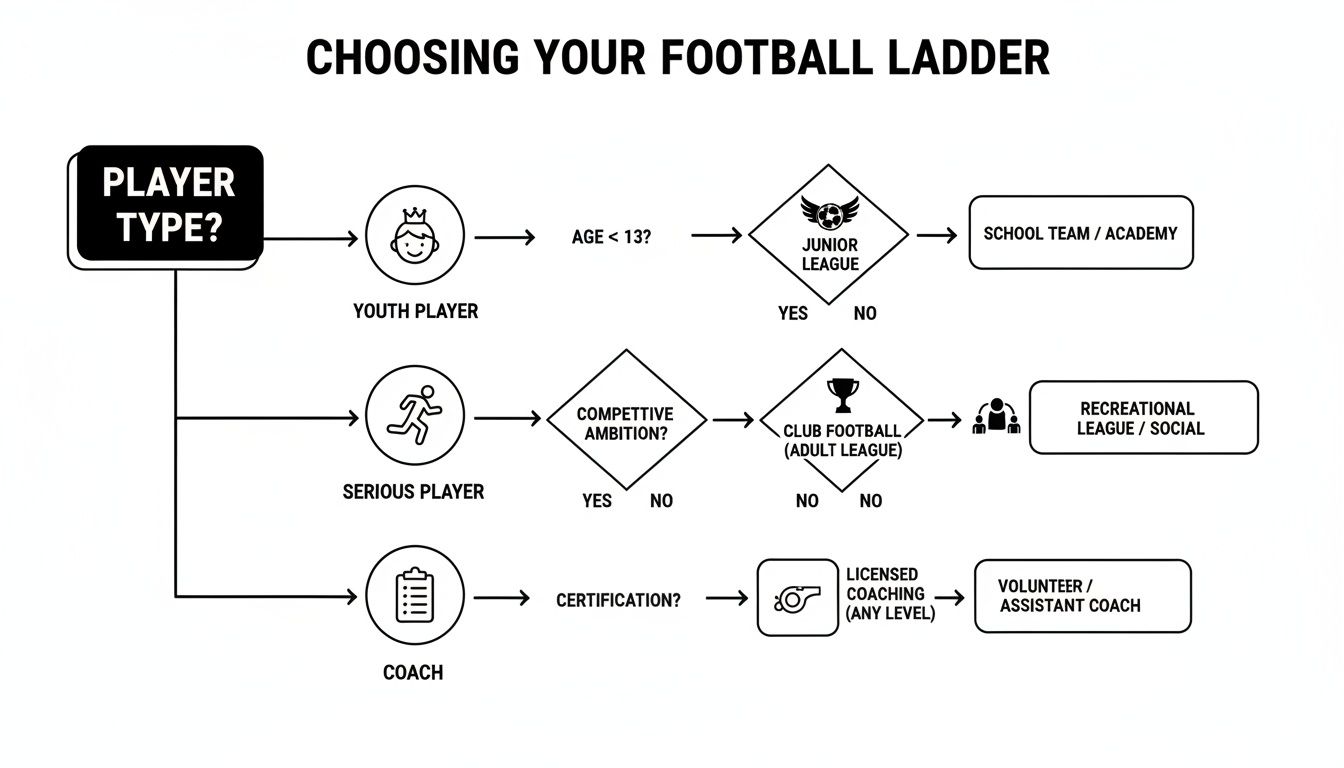
The infographic highlights that your role—whether you are a developing youth player, a serious athlete, or a coach managing a team—should guide your choice of equipment.
Dynamic and Football-Specific Movements
Once you've mastered the basics and they feel like second nature, it's time to progress to drills that better mimic the chaotic, stop-start nature of a real football match. These movements are designed to challenge both your body and your brain, forcing you to think and react in a split second.
The end goal is to make these patterns so automatic that you can execute them under pressure without conscious thought. This is where you'll start to see a genuine improvement in your performance on game day.
The purpose of these advanced drills is to bridge the gap between training and match play. By simulating the rapid changes of direction required to evade a tackle or track a forward, you are preparing your body for the physical demands of a real game.
Here are a couple of classic drills that deliver a massive impact:
-
The Ickey Shuffle: A true staple of agility work. Start with both feet just outside the first rung. Step your inside foot in, then your outside foot in. Next, step your inside foot out of the square on the other side, followed by your outside foot, moving you diagonally forward. Repeat this sequence all the way down.
- Why It Works: This is brilliant for developing the hip rotation and lateral foot speed needed to change direction in a flash, dodge challenges, and maintain balance while dribbling at pace.
-
The In-Out Weave: Face the ladder and start with both feet outside the first square. Step your right foot into the first square, then your left. Now step your right foot out to the right of the next square, followed by your left. Then, step your left foot into that second square, followed by your right. Continue this "in-in, out-out" weaving pattern.
- Why It Works: This movement directly simulates the footwork required for evasive dribbling and keeping the ball under close control when navigating a crowded midfield.
These drills are just the beginning. To explore a whole range of other exercises and learn how to structure them into a proper session, check out our complete guide to football agility ladder drills.
Remember, consistency is key. Regular practice is what turns these training drills into game-winning instincts.
Building Your Football Ladder Training Plan
Knowing a few ladder drills is one thing, but integrating them into a smart training plan is where the real on-pitch benefits emerge. A good programme isn't just about intensity; it's about balancing hard work with proper recovery so your body can adapt and get stronger.
Simply hammering away at the ladder without a plan is a recipe for hitting a plateau. The trick is to look at your entire week, figuring out where ladder work fits alongside team practices, gym sessions, and crucial rest days.
A smart training plan should always include strategies to prevent overtraining, because pushing too hard without adequate recovery is a quick way to get injured and lose all your progress. Balance is everything.
Structuring Your Weekly Sessions
So, how often should you use the ladder? For most players, two or three sessions a week is the sweet spot.
These don't need to be long sessions. A sharp, focused 15-20 minutes after your warm-up is more than enough to fire up your nervous system without leaving you fatigued for the rest of your training.
Here’s a simple way to structure your week:
- Session 1 (Early Week): Begin with the basics. Focus on perfecting your footwork, even if it means going slower.
- Session 2 (Mid-Week): Increase the intensity. Introduce more complex drills and movements that closely mimic match-day scenarios.
- Session 3 (Optional/Advanced): This is where you can add reactive drills to sharpen your game-day decision-making.
This approach builds a solid foundation first, then layers on complexity and intensity as you progress.
The goal of a training plan is not just to work hard, but to work smart. By integrating ladder drills with ball work and conditioning, you create a holistic programme that translates directly to better performance under pressure.
Progressive Overload and Reactive Training
To continue getting faster and sharper, you can't just repeat the same routine indefinitely. You need to apply a principle called progressive overload, which is simply a way of saying you have to make things slightly more challenging over time.
You can achieve this by trying to complete drills faster, reducing your rest time between sets, or tackling more complicated footwork patterns.
To make it truly game-realistic, start adding reactive elements. Have a teammate or coach shout commands like "left," "right," or "change!" mid-drill. This forces your brain to process information and react on the fly, just as you would when an opponent makes a sudden move.
It’s all about building that resilience and adaptability seen at the highest levels. Just look at Tottenham Hotspur in the English football league system—they have remained in the top flight for decades. That’s the kind of enduring performance great training builds.
Caring for Your Football Training Gear
Getting your hands on a quality football ladder is a great start, but keeping it in top condition is what truly matters. Proper care ensures it lasts season after season, ready for action whenever you are. A little bit of maintenance goes a surprisingly long way.
After a session, especially on a muddy pitch, give the ladder a quick wipe-down with a damp cloth. This simple habit prevents dirt and grime from building up on the nylon straps and plastic rungs. Always let it air dry completely before packing it away to prevent mildew.
When you're finished, fold or roll the ladder carefully to stop it from getting tangled. Using the carry bag it came with is easily the best way to keep it neat and protected. It's also worth giving it a quick inspection now and then to check for any fraying straps or cracked rungs.
Taking just five minutes to clean and store your ladder properly protects your investment, ensuring it remains a reliable part of your training arsenal.
For more advice, read our comprehensive guide on maintaining all your essential football training gear.
Common Questions About Football Ladders
Even when you're keen to get started, a few questions always arise when incorporating a new piece of kit into your training. Here are some of the most common queries we get from players, parents, and coaches about agility ladders.
How Often Should I Be Training with It?
For the best results, you'll want to use the ladder two to three times per week. The sessions don't need to be long and gruelling. A sharp, focused 15-20 minutes after your warm-up is the ideal duration.
This frequency is perfect for continuously reinforcing quick-feet patterns in your muscle memory without causing burnout. It keeps your neuromuscular coordination sharp, which is exactly what you need on match day.
Are Agility Ladders a Good Idea for Young Players?
Absolutely. Ladders are a fantastic, and genuinely fun, tool for young players learning their craft. They're brilliant for teaching the "ABCs" of movement—Agility, Balance, and Coordination—which are the bedrock of any successful athlete.
The golden rule with children, however, is to focus on correct form before chasing speed. The aim is to make mastering the movements an enjoyable challenge. For safety, we always recommend ladders with flat rungs, as this simple design feature dramatically reduces the risk of trips and stumbles while they're learning.
Will a Ladder Actually Make Me Faster?
This is an excellent question. A ladder is a crucial tool for improving the type of speed that truly matters on a football pitch: your acceleration, your ability to decelerate, and your lightning-fast changes of direction. It won't directly boost your top-end, 100-metre-sprint speed in the way dedicated track work would.
What it does do is perfect your footwork and refine your running mechanics, building the foundation for more explosive and efficient movement. This means you become quicker in the short, sharp bursts that win games. For the greatest impact, combine your ladder drills with proper sprint training.
Ready to take your agility to the next level? Explore the range of high-quality, durable training ladders at SoccerWares.
Find the perfect ladder to sharpen your skills at https://soccerwares.com.