

At its heart, 'pass and move' is exactly what it sounds like: you pass the ball to a teammate and immediately move into a new, better space. It's a simple, two-step sequence, but it is the foundation of possession-based football and the key to unlocking creative, attacking play.
The Philosophy of Pass and Move Football
'Pass and move' is more than just a coaching command shouted from the touchline. It’s a philosophy that shifts a team's focus from individual brilliance to a fluid, collective effort. It's the engine that drives the beautiful game, allowing teams to control the tempo, pull defences apart, and dictate the flow of a match.
This approach is about ditching static, predictable football. Instead, you create an environment of constant, intelligent movement.
This philosophy hinges on a few core ideas. It champions the team over the individual and rewards players for thinking ahead. When a team masters this, the ball does the heavy lifting, moving quickly between players who are already thinking about their next action.
Creating Intelligent Players
A team that truly grasps the pass and move concept stops reacting and starts anticipating. Players learn to scan the pitch before they receive the ball, knowing where their next pass is going or which run they need to make. This builds a huge amount of game intelligence and spatial awareness.
Drilling this style sharpens several key skills at once:
- First Touch: A player’s first touch must be purposeful. It needs to set up the next pass, not just stop the ball dead.
- Decision-Making: With less time on the ball, players are forced to think faster and make smarter choices under pressure.
- Off-the-Ball Movement: The "move" is just as crucial as the "pass." Players learn how to create passing angles, drag defenders out of position, and offer support to their teammates.
The core idea is simple: your pass is your ticket to move. It's a signal that you've completed one action and are immediately starting the next, keeping the opposition constantly guessing.
To give your players a quick reference, here are the essential ideas to reinforce during your sessions.
Core Principles of Pass and Move Football
| Principle | Objective for Players | Impact on the Game |
|---|---|---|
| Play One and Two-Touch | Receive the ball cleanly and pass it quickly. Avoid unnecessary dribbling. | Increases the speed of play, making it harder for defenders to close down. |
| Move After Passing | Immediately move into a new space to create a passing option or draw a defender away. | Creates passing lanes and disrupts the opponent's defensive shape. |
| Think Ahead | Know what you're going to do with the ball before it arrives. Scan the pitch constantly. | Speeds up decision-making and leads to more fluid, proactive play. |
| Create Angles | Always move to create a clear passing angle for the player with the ball. Avoid hiding. | Ensures the player in possession always has options and reduces turnovers. |
| The Ball Does the Work | Let the ball move quickly between players rather than relying on one player to run with it. | Conserves player energy and exhausts the opposition who have to chase. |
These principles are the building blocks for a dynamic and effective team.
The Tactical Impact on the Pitch
The tactical payoff of a well-drilled pass and move system is huge. It puts the defending team on the back foot, forcing them to constantly chase the ball and plug gaps that keep appearing. This relentless movement can wear opponents down, both physically and mentally.
It's also the cornerstone of possession football. By keeping the ball moving, your team can manage the game’s rhythm—slowing it down to keep control or upping the tempo to exploit a sudden opening. If you want to dive deeper into this style, our guide on possession soccer drills is a great next step.
Ultimately, mastering this philosophy is about turning eleven individuals into a single, intelligent unit that controls space, time, and the ball.
Essential Warm-Ups for Passing and Movement
Before your players dive into the main session, a proper warm-up is non-negotiable. This means more than just a few laps to raise the heart rate. We need to prime their bodies and minds for the specific actions of passing and moving. A good warm-up activates the right muscles, sharpens that first touch, and gets players thinking about space and awareness from the very first kick.
Skipping this step often leads to sluggish starts and, even worse, a higher risk of injuries. Dynamic warm-ups that mimic in-game actions are far more effective than static stretching. We want to get the neuromuscular system firing, ready for the quick decisions and crisp execution that pass-and-move football demands. Get this right, and you set the tone for a sharp, focused session. For a deeper look into player safety, we’ve covered some great advice in our football injury prevention tips.
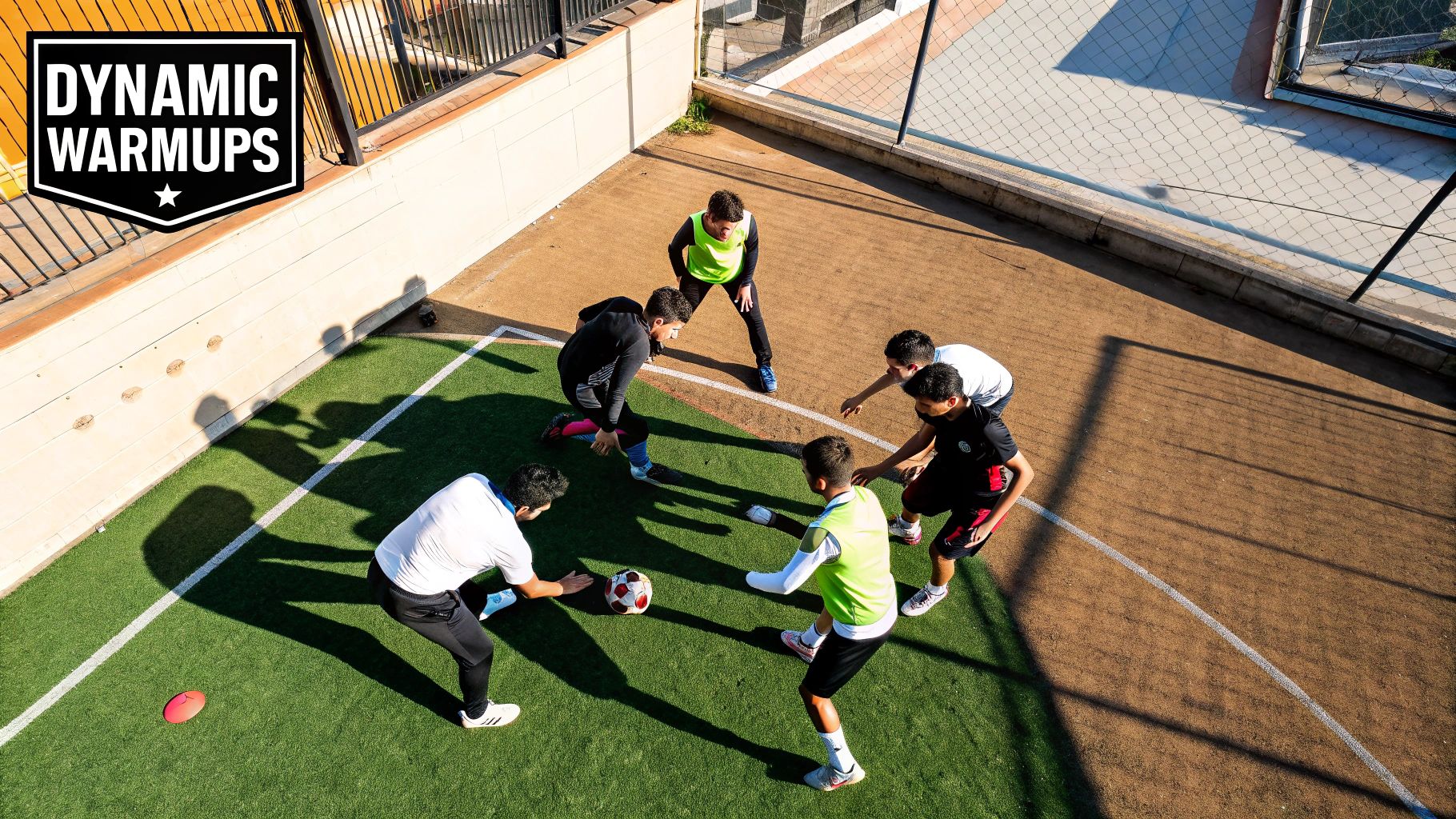
Rondo Variations: ‘Piggy in the Middle’
The classic Rondo, or 'Piggy in the Middle', is the perfect starting point. It’s a simple game of keep-away that organically teaches passing, movement, and awareness under light pressure. The best part is that it’s incredibly easy to scale for any age or skill level.
Setup and Execution: Mark out a circle or square with cones, about 10x10 yards for a 5v2 setup (five attackers, two defenders). The attackers’ goal is to keep possession, while the two defenders in the centre try to win the ball.
Coaching Points to Emphasise:
- Play on Your Toes: Players need to be light on their feet, ready to shift their body to receive or move into a new space. This isn't optional; it's a fundamental state of readiness.
- Scan Before You Receive: Get them into the habit of looking over their shoulder before the ball arrives. This quick check helps them spot their next pass or an open channel to move into.
- One and Two-Touch Play: Challenge them to play quickly. A one-touch pass is the goal, but a crisp two-touch (control, pass) is just as effective. Stamp out unnecessary dribbling.
The real magic of the Rondo isn't just about keeping the ball. It's about teaching players to think collectively, creating passing angles for each other, and understanding the rhythm of quick ball circulation.
Dynamic Passing Gates
This is another fantastic warm-up drill. Passing gates focus on the accuracy of the pass and the quality of the receiver’s movement into space. It forces players to be deliberate with every action.
Setup and Execution: Scatter several pairs of cones (gates) randomly across a grid, say 20x20 yards. Each gate should be about two yards wide. Players get into pairs with one ball between them.
The idea is for one player to pass to their partner through any gate. As soon as they make the pass, they must immediately sprint to a different gate to receive the return pass. This constant cycle of pass-move-receive gets them thinking and moving across the grid.
Progressions to Increase Difficulty:
- Add a Third Player: Introduce a third player to create a 3v1, where a passive defender tries to block passing lanes.
- Limit Touches: Restrict players to just two touches—one to control and one to pass. This really puts the pressure on their first touch.
- Specify Gate Colour: Use different coloured cones for the gates. Shout out a colour, and players must pass through a gate of that specific colour, adding a cognitive challenge.
Beyond the drills, proper preparation includes what players do off the pitch. For instance, you can master your performance with a smart plan for hydration to ensure they're always ready to train at their best. By combining active warm-ups like Rondos and passing gates, you’ll have players who are not just physically warm but also mentally switched on for the main session.
Progressing Your Pass and Move Drills
Once your players have a feel for the basic rhythm in the warm-up, it’s time to lay the groundwork. This is where we move beyond simple patterns and start building more complex, game-realistic sequences. Using progressive drills is key—they let you introduce new ideas in a controlled way, building muscle memory and confidence before players face the chaos of a real match.
The trick is to add layers of complexity one at a time. We'll start with the most fundamental partnership in football—two players—and build up from there. Each new drill will add another variable, another decision to make, or a different type of movement, keeping players engaged without feeling overwhelmed.
Starting with Two-Player Drills
The simplest pass and move drills begin with just two players. This stripped-back setup isolates the two core actions: the quality of the pass and the timing of the movement that follows. Forget tactics for a moment; this is all about crisp, clean execution.
Drill 1: The Basic Pass and Follow
This is the absolute bedrock of passing and moving. Get two players to stand about 10-15 yards apart.
- Player A passes the ball firmly on the ground to Player B.
- The moment the ball leaves their foot, Player A sprints towards where Player B is standing.
- Player B takes a touch to control the ball, then plays it back into the space Player A is running into.
- Player A receives the return pass on the move, and the cycle starts again.
The beauty of this drill is its simplicity. It trains the passer to move instantly and gets the receiver thinking about the weight of their return pass.
Coaching Cue: "Your pass is your trigger to move!" This simple phrase is brilliant for reinforcing the idea that the pass and the movement are a single, connected action.
Advancing to Triangular Patterns
When your players are nailing the two-player exchanges, bringing in a third player opens up a world of tactical options. Triangles are the foundation of possession football because they create multiple passing angles and force defenders into difficult decisions. You can easily mark out the corners of your triangle with a few high-visibility Training Cones.
Drill 2: The Third-Man Run
The third-man run is a classic combination that can cut through almost any defence. It’s all about three players working in perfect sync to create an opportunity.
- Arrange three players in a triangle, roughly 15 yards apart.
- Player A passes to Player B.
- As that pass travels, Player C makes an explosive run forward into space.
- Player B plays a first-time "wall pass" straight into Player C's path.
This drill teaches players to think a couple of steps ahead. Player A starts the move, Player B acts as the pivot, and Player C provides the cutting edge with their run. It’s a perfect illustration of how coordinated movement can pull a defence apart.
Incorporating Diamond Formations
Adding a fourth player to make a diamond shape dials up the complexity and realism even more. A diamond gives the player on the ball options for width and depth—they can play short to the side, long and forward, or safe and backwards.
This formation is fantastic for developing a player's ability to scan the pitch and make good decisions. A versatile tool like soccer training poles can add another layer to these drills, serving as passive defenders or gates to dribble through.
Drill 3: The Diamond Rotation
In this drill, the ball moves around the diamond, and players follow their pass, which creates constant, fluid rotation.
- Set up four players in a diamond shape.
- Player 1 (at the bottom) passes to Player 2 (on the right).
- As they pass, Player 1 moves to where Player 2 was.
- Player 2 receives the ball, passes to Player 3 (at the top), and follows their pass.
- The pattern continues around the diamond, with every player moving into the next position.
This non-stop movement is exactly what you see from top-tier teams and does wonders for building team chemistry and understanding.
Smart Variations to Keep Sessions Engaging
Repetition is vital for improvement, but it can get boring. To keep players switched on and challenged, it’s a good idea to introduce small variations to your drills. These tweaks can make a huge difference.
Effective Drill Variations:
- Limit Touches: Restricting players to one or two touches is one of the best ways to raise the tempo. It forces them to think quicker, sharpen their first touch, and move the ball at speed.
- Add Passive Defenders: Add a defender or two who can only shadow players or block passing lanes—no tackling allowed. This gets attackers used to shielding the ball and finding better angles under light pressure.
- Introduce a 'Bounce' Player: Use a neutral player (or a coach) who can be used by the team with the ball. They typically play one-touch, acting as a "wall" to set up quick one-twos and third-man runs.
- Shrink the Area: Making the playing area smaller gives everyone less time and space. It’s a natural way to force players to improve their close control, speed of thought, and accuracy under pressure.
By building up from simple two-player drills to more complex diamond patterns—and adding these smart variations—you create a complete understanding of pass and move football. Each layer adds a new skill, helping you develop well-rounded, intelligent players who can adapt on match day.
Applying Skills in Small-Sided Games
Structured drills are brilliant for building muscle memory, but the real test is seeing if those skills hold up under pressure. This is where small-sided games (SSGs) come in. They perfectly bridge the gap between clean, repetitive patterns and the beautiful chaos of a proper match.
By shrinking the pitch and reducing the number of players, SSGs naturally force more touches, quicker decisions, and better communication. It’s the ideal environment to embed your pass and move philosophy into the team’s DNA.
You can see how the basic patterns we practise build into more game-like shapes here.
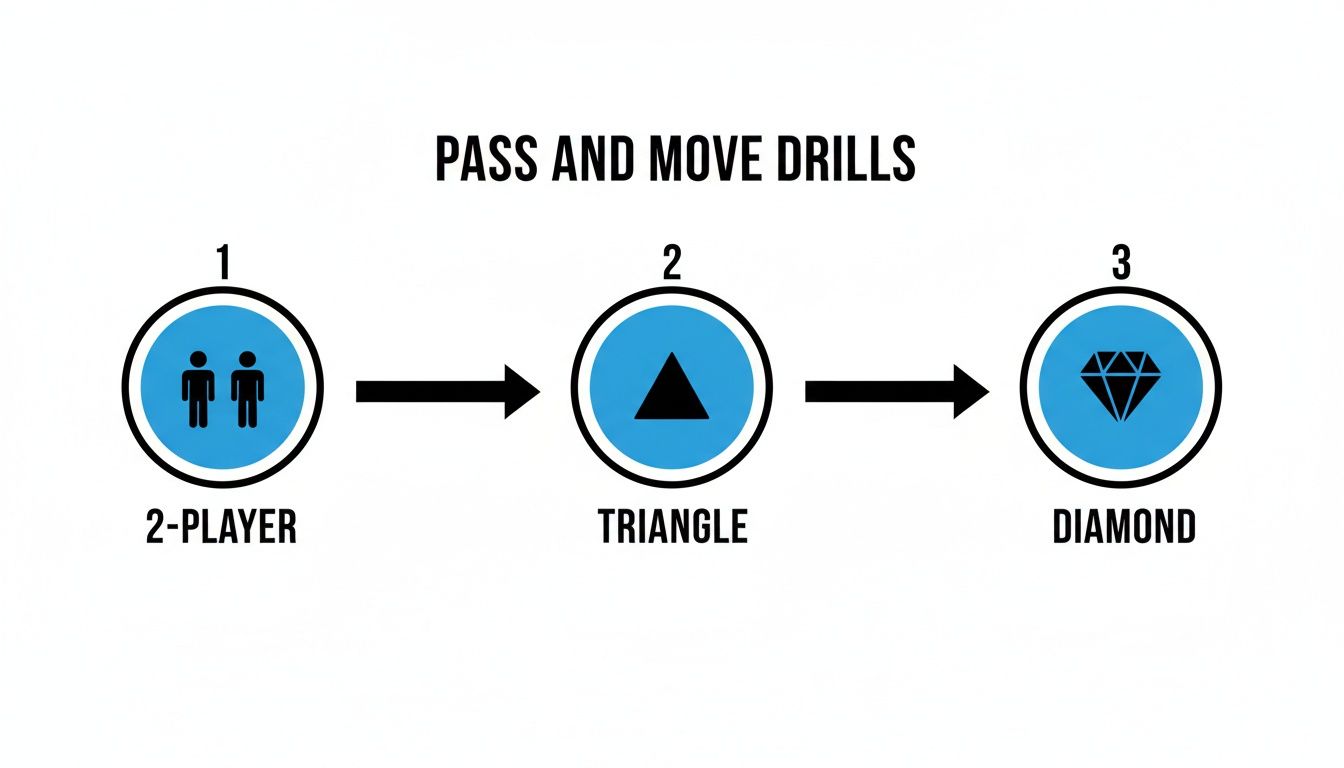
This visual shows how we start with simple two-player link-ups before moving to triangles and diamonds that appear all over the pitch during a real game.
Designing Effective Small-Sided Games
The secret to a great SSG isn't just letting players have a kickabout. It’s about designing the game with specific rules or "conditions" that encourage the exact behaviours you want to see. Your aim is to create an environment where passing and moving isn’t just an option—it becomes the best and most logical one.
A standard 4v4 or 5v5 is a fantastic starting point. In these tight spaces, trying to dribble past three defenders is a recipe for losing the ball. Players quickly learn that moving it quickly is far more effective.
Introducing Conditions to Encourage Movement
Once you have your basic game running, you can start layering in clever rules to nudge players towards the pass-and-move mindset. Think of these conditions as invisible coaches, rewarding the right actions without you having to blow the whistle every 30 seconds.
Here are a few of my go-to conditions:
- The Consecutive Pass Bonus: Award a bonus point (or count it as a goal) for completing a set number of passes. Start with five consecutive passes and watch what happens. Players almost immediately start moving into better supporting positions to keep the chain going.
- The 'All-Player' Rule: This one is brilliant for teamwork. The rule is simple: every player on the attacking team must touch the ball before they can shoot. It forces patience and makes everyone feel involved in the build-up.
- Limited Touches: A true classic for a reason. Restrict everyone to a maximum of two or three touches. The tempo of the game instantly lifts, and players are forced to think one step ahead, moving off the ball to become an option for their teammate.
The real objective of a small-sided game isn't winning; it's learning. By cleverly conditioning the rules, you can steer players towards better habits without having to constantly stop the game.
Drill Progression and Equipment Guide
To get the most out of these drills, having the right gear helps you set up quickly and keep the session flowing. Here’s a simple guide matching our drill progression with the ideal equipment.
| Drill Type | Primary Coaching Focus | Recommended Soccerwares Equipment |
|---|---|---|
| Basic Patterns (2-Player) | Technique, passing accuracy, first touch | 10 Training Cones to mark positions |
| Triangle & Diamond Drills | Movement off the ball, creating angles | 20 Disc Cones and 4 Agility Poles for gates |
| Small-Sided Games (SSGs) | Decision-making, game intelligence | 2 Portable Goals and Training Bibs to define teams |
Having a solid set of cones, poles, and portable goals means you can adapt your session on the fly and create a professional, engaging environment for your players.
Creating Realistic Game Scenarios
To take your SSGs to the next level, start creating scenarios that your players will face on match day. This adds a tactical layer to all the technical work you've been doing and helps them understand the why behind the pass and move.
A couple of scenario ideas to try:
- Possession vs. Counter-Attack: Set up a 5v3 where the team of five has to complete ten passes to "score." If the team of three wins it back, they have just eight seconds to score in one of two mini-goals. This teaches the possession team to value the ball while training the defenders to be ruthless on the break.
- Wide Play Emphasis: Use a pitch that is much wider than it is long. Set a condition that any goal scored from a cross or a cut-back is worth double. You’ll see players start to use the full width, make overlapping runs, and focus on the quality of their final ball.
These game-based drills give context to the skills. Players finally connect the dots, realising why passing and moving is so crucial to creating chances and winning games. The core principles of creating space are also vital in smaller formats, which we cover in more detail in our guide to 5-a-side tactics for beginners.
Effective Coaching Cues and Common Player Mistakes
Setting up the cones and explaining a drill is the easy part. The real coaching—the part that genuinely develops players—happens in the moments between the passes. It’s about what you see, what you say, and how you say it.
This is where you make your biggest impact. You're not just running an exercise; you're teaching game intelligence. A well-timed, simple cue can transform a player who goes through the motions into one who thinks, anticipates, and reacts. It's about turning a physical drill into a mental lesson.
Spotting and Fixing Common Errors
In any pass-and-move drill, you’ll see the same handful of mistakes crop up again and again, especially with younger age groups. The trick is to spot them early and have a simple fix ready. Let's break down the most common ones.
Mistake 1: The Post-Pass Spectator
This is the big one. A player makes a pass and then stops. They stand still and admire their work, instantly taking themselves out of the game. This kills momentum, reduces passing options, and puts their teammate under pressure.
- The Simple Fix: Drill into them that the pass isn't the end of their job; it's the start of the next one. The second the ball leaves their foot, they must move into a new space. It doesn't always have to be a full sprint forward—any intelligent movement that offers support, creates a new passing lane, or drags a defender away is a win.
- Coaching Cue: "Your pass is your ticket to move!" It’s a simple, memorable phrase that links the two actions together in their minds.
Mistake 2: Playing with Tunnel Vision
You see it all the time: a player is so focused on controlling the ball or making the perfect pass that their head is down. They are playing blind to everything happening around them. This leads to predictable passes, missed chances, and an inability to read the game.
- The Simple Fix: Get them into the habit of scanning before the ball arrives. A quick glance over each shoulder gives them a mental picture of where everyone is—teammates, opponents, and, most importantly, space. It allows them to decide their next move before they’ve even taken their first touch.
- Coaching Cue: "Picture, pass, move." This three-word sequence is easy to remember. Get a picture of the pitch, execute the pass, and then get moving.
Taking Movement to the Next Level
Once your players have nailed the basic rhythm of passing and moving, it’s time to refine the quality of their runs and decisions. It’s not just about moving anymore; it’s about moving with purpose.
Mistake 3: The Predictable Forward Run
A player passes and immediately sprints straight forward every single time. While running beyond the ball is crucial, if it’s the only move they have, defenders will read it easily. Great attacking play is built on unpredictable movement that pulls a defence apart.
- The Simple Fix: Introduce variety into their runs. Show them how to check back towards the ball to offer a short, safe option. Teach them to make arched runs to create width, or sharp diagonal runs to drag a defender into an area they don’t want to go.
- Coaching Cue: "Don't just run; run with a reason." This simple prompt forces them to think. Why are you moving? Are you trying to get the ball back, create space for someone else, or provide support?
The best players understand that their movement off the ball is just as important as their skill on it. They use their runs to manipulate the defence, creating opportunities not just for themselves, but for the entire team. This is the essence of intelligent football.
Your Questions About Pass and Move Drills Answered
Even with the best-laid plans, questions always come up on the training ground. Answering them helps you tweak your sessions for maximum impact and makes sure your players are buying into the why behind each drill. Here are a few of the most common things coaches ask when running pass-and-move sessions.
How Can I Adapt These Drills for Younger Age Groups?
For younger players, especially in the U7-U10 age range, the golden rule is to keep it simple and fun. Forget about complex diamond patterns or third-player runs for now.
Start with the basics. A simple "pass and run to a cone" drill works wonders. With no defenders, there's a high chance of success, building their confidence from the start. Using colourful training cones gives them bright, clear targets. The focus should be on the quality of their pass and first touch, not deep tactical thinking.
In small games, like a 3v3, add a simple condition: players must make at least one pass before they can shoot. The goal here isn't to create a tiki-taka masterpiece. It's to build the fundamental habit of moving immediately after passing. Keep your instructions short, provide plenty of encouragement, and celebrate the movement as much as the pass itself.
What Is the Biggest Challenge When Teaching Pass and Move Football?
Without a doubt, the biggest hurdle is getting players to unlearn the "dribble-first" instinct. Many young players naturally want to put their head down and run with the ball. The challenge is shifting their mindset to see a quick pass as the fastest and smartest way up the pitch.
How do you fix it? Use drills that force quick decisions. A simple two-touch limit in any small-sided game is brilliant for this. It takes away the option to dribble into trouble and makes them lift their heads to find a teammate. In training games, make a massive deal out of a clever pass or a great off-the-ball run. Cheer for it just as loudly as you would for a goal. That's how you reinforce the behaviour you want to see.
Progress isn't just measured in goals scored. It's in the quality of your build-up play. When you see a player choose a smart, simple pass over a risky dribble, you know the philosophy is starting to stick.
How Do I Measure My Team's Improvement?
You can track progress in two ways: what you can see and what you can count.
The first way is qualitative—you’ll start to notice it during matches. Your team's spacing will look better organised. Players will make more intelligent runs into dangerous areas without being told. You'll see their decision-making under pressure become quicker and calmer. It will all look more fluid.
The second way is quantitative. Start tracking simple stats during your small-sided games. For instance, count the number of consecutive passes a team completes before losing possession. If that number starts to climb over a few weeks, it's a clear, measurable sign that they're getting it. To keep your players performing at their best, remember that proper nutrition is crucial. Fuelling them with the right high protein snacks for athletes can make a real difference to their energy levels and recovery.
At SoccerWares, we provide the high-quality equipment you need to run effective, engaging training sessions. From cones and bibs to portable goals, we have everything to help you coach the beautiful game. Explore our full range of training essentials at https://soccerwares.com.