

“Attack wins you games, defence wins you titles.” It's a cliché for a reason. A solid, organised defence is the bedrock of any successful football team, providing the stability and confidence needed to win matches consistently. Building an impenetrable backline, however, doesn’t happen by chance; it’s forged on the training ground through repetition, tactical understanding, and a commitment to mastering the fundamentals.
Whether you’re a grassroots coach aiming to instil discipline in a youth team, a player looking to elevate your individual defensive game, or a parent supporting your child's development, the right drills are essential. This guide offers a curated collection of eight essential soccer defence drills designed to improve every facet of defending. From mastering individual 1v1 duels and organised pressing to executing flawless recovery runs, we provide a blueprint for a stronger defensive unit.
Each drill is broken down with clear, step-by-step instructions, crucial coaching cues, and practical progressions to keep training sessions challenging and effective. We’ll cover everything from individual technique to cohesive team shape. While these drills focus on specific football skills, a player's overall physical readiness is equally important. Understanding broader general training principles can complement a player's development, ensuring they are physically prepared for the demands of high-intensity defending. Get ready to transform your team's defensive capabilities, build confidence from the back, and turn your goal into a fortress.
1. 1v1 Marking Drill
The 1v1 marking drill is the cornerstone of individual defensive training, focusing on the fundamental battle between a defender and an attacker. In this exercise, a defender is tasked with closely shadowing an attacker within a confined area, learning to deny space, prevent turns, and dictate the attacker's movement. It's one of the most essential soccer defence drills because it isolates the core principles of defending: body positioning, footwork, anticipation, and tackling, all without the complexity of a full-game scenario.
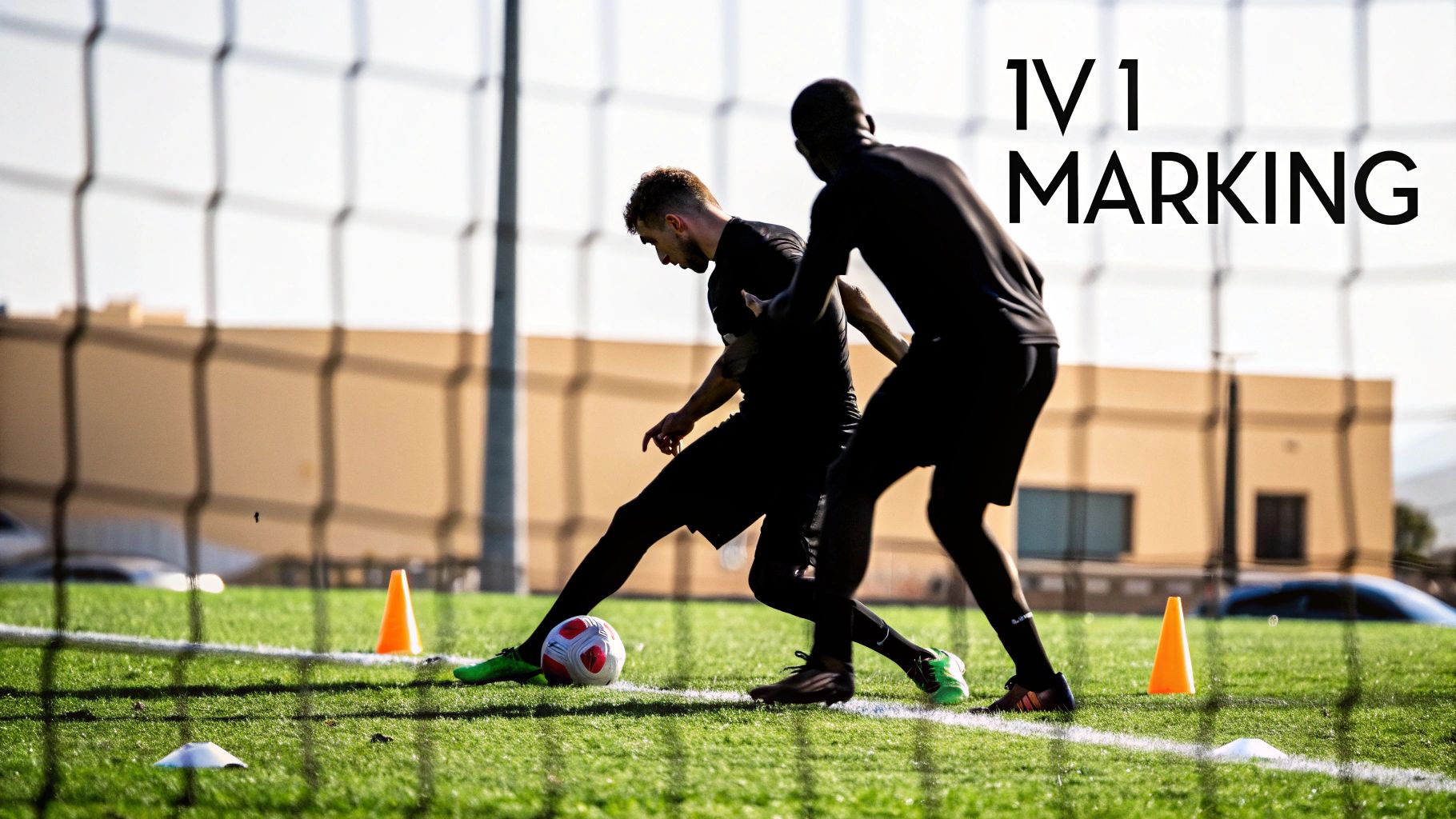
This drill forces defenders to become comfortable in uncomfortable situations, honing their ability to stay "goal-side" (between the attacker and the goal) and maintain an arm's length distance. Elite managers like Pep Guardiola and Jürgen Klopp have popularised this focused training, realising that a team's collective strength is built upon individuals who can win their personal duels. Defenders at top clubs are renowned for their aggression and intelligence in one-on-one situations, a direct result of this type of targeted practice.
How to Implement the Drill
Setting up the 1v1 marking drill is straightforward, making it perfect for any training session.
- Objective: To improve a defender's ability to stay close to an attacker, read their movements, and prevent them from receiving or turning with the ball.
- Equipment: A set of durable training cones, like the ones from SoccerWares, and one football.
- Setup: Create a 10x10 metre grid using the cones. One attacker starts inside the grid, and one defender marks them. A coach or server stands outside the grid with the ball.
- Execution: The server passes the ball to the attacker. The defender’s job is to prevent the attacker from turning and dribbling out of the grid or to win the ball back. The attacker’s goal is to receive the ball under control and exit the grid on any side. Rotate players every 60-90 seconds.
Coaching Cue: "Stay on your toes, not flat-footed. A low centre of gravity allows you to react quickly to the attacker's feints and changes of direction. Keep your eyes on the ball and the opponent's hips."
Progressions and Variations
To keep the drill challenging, you can introduce progressions:
- Increase Space: Expand the grid to 15x15 or 20x20 metres to test the defender's ability to cover more ground.
- Add Goals: Place small goals at each end of the grid. The attacker must score in one, and the defender can score in the other upon winning possession.
- Record and Review: Use a sports camera to film the sessions. Reviewing footage helps defenders see their positioning and body shape from an objective viewpoint, accelerating their development.
2. Pressing and High Defensive Line Drill
Modern football has embraced an aggressive, front-foot defensive philosophy, and the pressing and high defensive line drill is central to this evolution. This drill teaches a unit to work cohesively to pressure opponents high up the pitch, aiming to win the ball back in dangerous areas rather than retreating. It’s a crucial component in any list of soccer defence drills because it shifts the focus from reactive defending to proactive, organised aggression, disrupting the opposition's build-up play before it can begin.
This strategy, famously implemented by managers like Jürgen Klopp and Pep Guardiola, relies on synchronised movement, intense work rate, and high levels of communication. Teams like Liverpool and Manchester City have mastered this approach, using coordinated pressing triggers to force mistakes and create immediate goal-scoring opportunities. The drill trains defenders not just to tackle, but to anticipate, close down space, and maintain a compact high line, which requires a deep understanding of positioning to avoid being caught out by long balls.
How to Implement the Drill
This drill simulates the pressure and decision-making required to execute a high press effectively.
- Objective: To improve a defensive unit’s ability to press as a group, maintain a high line, and force turnovers in the opposition's half.
- Equipment: A full set of cones to mark out a large playing area and one football.
- Setup: Mark out a grid from the halfway line to one of the penalty areas. Set up a team of 4 defenders against a team of 5 or 6 attackers. The attacking team starts with the ball from their "goalkeeper" (a coach or player at the edge of the penalty area).
- Execution: The attacking team’s goal is to play the ball through the lines and score in a full-sized goal. The defending team’s objective is to press together, based on specific triggers (e.g., a pass to a full-back, a bad touch), win the ball back, and score in two smaller counter-attacking goals positioned on the halfway line. The high line must move up and drop in unison. A solid grasp of the rules is essential for this drill, and you can learn more by explaining offsides in soccer with this guide.
Coaching Cue: "Press as one! The nearest player applies pressure to the ball, while the others cut off passing lanes and provide cover. Your body shape should force the attacker wide and away from goal."
Progressions and Variations
To develop the unit’s pressing intelligence, add layers of complexity:
- Introduce a Time Limit: Give the attacking team a set time (e.g., 10 seconds) to score, forcing the defenders to press with urgency.
- Increase Player Numbers: Progress to 6v7 or 8v9 situations to replicate more realistic game scenarios and test communication under greater pressure.
- Monitor Performance Data: Use GPS trackers to analyse player positioning, distances covered at high intensity, and the compactness of the defensive unit. This data provides tangible feedback on the effectiveness of the press.
3. Defensive Shape and Positioning Drill
While individual duels are crucial, a team's defensive strength lies in its collective organisation. The defensive shape and positioning drill shifts the focus from one-on-one battles to the unit's cohesion, teaching players how to maintain proper formation, spacing, and discipline. This exercise is one of the most vital soccer defence drills for developing a backline that moves as one, preventing gaps and frustrating attackers through sheer solidarity. It prioritises intelligent organisation over last-ditch individual heroics.
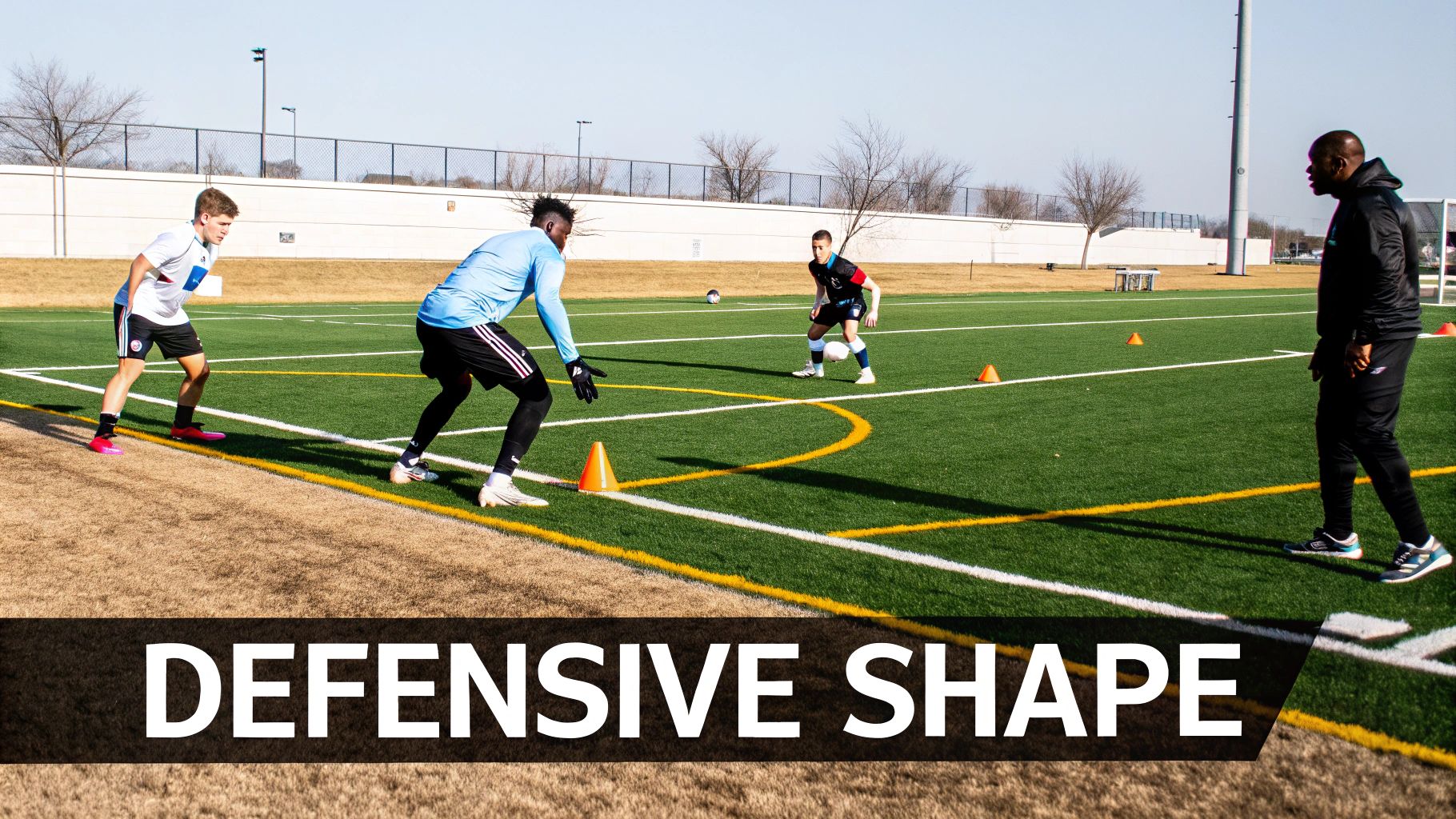
This drill trains defenders to adjust their positions in relation to the ball, their teammates, and the opposition. Managers like Mikel Arteta at Arsenal and Gareth Southgate with the England national team have built their success on this foundation of positional discipline. Their teams are renowned for their compactness and ability to control space, a direct outcome of repeated practice in maintaining defensive shape. The drill instils the principles of shifting, covering, and communicating effectively as a unit.
How to Implement the Drill
Setting up this drill requires clear reference points to guide players' positioning, making it perfect for structured coaching sessions.
- Objective: To improve a defensive unit’s ability to maintain a compact shape, adjust positions based on the ball’s location, and deny passing lanes.
- Equipment: A set of versatile training cones and coloured markers from SoccerWares to define zones, and one football.
- Setup: Mark out a half-pitch area. Position a back four (or back three/five) in their defensive shape. Place five or six attacking players (or cones to represent them) in various positions ahead of the defence. A coach starts with the ball.
- Execution: The coach slowly moves the ball across the pitch, from side to side and forward to back. The defensive unit must shift together, maintaining their spacing and shape relative to the ball. The coach passes the ball to one of the static attackers, and the defenders adjust to press and cover accordingly. Focus initially on movement without a tackle, then progress to live play.
Coaching Cue: "Move on the travel of the ball, not when it arrives. Stay connected with a 'rope' between each defender. If one moves, you all move. Communication is key to staying organised."
Progressions and Variations
To build on the basic principles and increase the challenge, introduce these progressions:
- Dynamic Attackers: Allow the attacking players to move and pass the ball amongst themselves, forcing the defensive unit to react to more unpredictable scenarios.
- Add Midfielders: Integrate defensive midfielders into the drill to work on the connection and screening between the defensive and midfield lines.
- Transition to Defend: Start the drill with an attacking phase. When the attacking team loses the ball, they must quickly transition into their defensive shape, testing their reaction speed and organisation.
4. Defensive Block and Barrier Drill
The defensive block and barrier drill is a specialised exercise designed to master the art of defending set-pieces. This drill focuses on teaching players how to block shots, close down space, and form protective walls during free kicks and corners. It’s one of the most vital soccer defence drills because a significant percentage of goals are conceded from dead-ball situations. Mastering this drill instils collective responsibility and the courage required to put your body on the line.
This drill directly translates to match-day resilience, where a single, well-timed block can be the difference between a clean sheet and defeat. Premier League clubs, with their dedicated set-piece coaches and analysis platforms, have turned set-piece defending into a science. Teams that gain a competitive advantage through highly organised defensive protocols do so through focused training that starts in academies and is perfected at the professional level.
How to Implement the Drill
Organising the defensive block and barrier drill is simple and directly mimics a high-pressure game scenario.
- Objective: To improve players' body positioning, timing, and courage when blocking shots and to enhance the team's organisation in forming a defensive wall.
- Equipment: A set of footballs, cones to mark the free-kick spot, and a full-size goal. Training mannequins can be used to simulate attackers.
- Setup: Place a ball on a cone 20-25 metres from the goal. A group of four or five defenders forms a wall, positioned ten metres from the ball as per the rules. A server or coach acts as the free-kick taker.
- Execution: The coach strikes the ball towards the goal, aiming over or around the wall. The players in the wall must time their jump, stay together, and present as large a barrier as possible. The aim is to block the shot or force it off target. Rotate players in the wall after several attempts.
Coaching Cue: "Stand side-on when blocking to protect sensitive areas and make your body bigger. Stay compact, close the gaps, and jump vertically on the shooter’s approach. Don't turn your back!"
Progressions and Variations
To elevate the drill's intensity and realism, consider these adjustments:
- Add Live Attackers: Position attacking players near the wall or goal to challenge for rebounds, forcing defenders to react after the initial block.
- Vary the Angle: Take free kicks from different angles and distances to challenge the wall's positioning and the goalkeeper's communication.
- Use Rebounders: A soccer rebounder can be used to simulate unpredictable deflections, training defenders' reaction times to second balls.
- Analyse Performance: Using a sports camera to film the drill allows for detailed video analysis, helping players correct their stance, timing, and positioning with visual feedback.
5. Recovery and Covering Drill
The recovery and covering drill is a high-intensity exercise designed to build defensive resilience and teamwork. It simulates a common, yet critical, scenario where a defender is beaten, forcing a teammate to provide cover while the original defender recovers their position. This is one of the most dynamic soccer defence drills as it trains not just individual speed but also the collective understanding and communication required to shut down threats after a defensive line has been breached.
This drill instils the "never give up" mentality essential for modern defenders. High-pressing teams often rely on their players' ability to execute rapid recovery runs to maintain their aggressive defensive structure. For them, a defender being dribbled past isn't a failure, but a trigger for a well-rehearsed recovery and covering sequence. This ensures defenders are adept at plugging gaps dynamically.
How to Implement the Drill
This drill can be adjusted for different skill levels and focuses on coordination, speed, and decision-making.
- Objective: To improve a defender's recovery speed after being beaten and to teach covering defenders how to delay an attacker and provide support.
- Equipment: A set of cones to mark the area and one football per group.
- Setup: Create a channel about 20 metres wide and 30 metres long, leading towards a full-sized goal with a goalkeeper. Two defenders (D1 and D2) start at cones placed centrally, about 25 metres from goal. An attacker (A) starts with a ball ten metres in front of them.
- Execution: The attacker (A) starts by dribbling at the first defender (D1). D1’s job is to engage the attacker. The coach will shout "Go!" at which point the attacker accelerates past D1. D1 must perform a recovery run to get back goal-side. Simultaneously, the second defender (D2) moves across to cover and delay the attacker, buying time for D1 to recover. The drill ends when the attacker shoots or the defenders win the ball.
Coaching Cue: "Covering defender: your job is to delay, not to dive in! Adopt a low, side-on body shape to show the attacker away from goal. Recovering defender: take the shortest route back towards your own goal, don't follow the ball."
Progressions and Variations
To increase the complexity and game-realism, consider these adjustments:
- Add Another Attacker: Introduce a 2v2 scenario, forcing the covering defender to also be aware of a passing option. This enhances communication and decision-making.
- Vary the Starting Point: Have the attacker start from wide areas to simulate recovery from a full-back being beaten.
- Incorporate Agility Work: Before the drill begins, have defenders complete a quick sequence from our football agility ladder drills to prime their explosive footwork for the recovery run.
6. Small-Sided Game Defensive Focus (4v4, 5v5)
Small-sided games are more than just a fun end to a training session; they are powerful tools for developing collective defensive understanding in a realistic, high-intensity environment. By reducing the pitch size and number of players (e.g., 4v4 or 5v5), the game forces more frequent defensive actions, quicker decision-making, and better communication. This approach is one of the most effective soccer defence drills because it bridges the gap between isolated exercises and a full 11-a-side match, teaching players how to apply their skills under pressure.
This methodology was heavily influenced by the Dutch "Total Football" philosophy and institutionalised at academies like FC Barcelona's famed La Masia. Modern coaches like Pep Guardiola use small-sided games as a primary developmental tool to instil tactical principles. The condensed space naturally encourages defenders to maintain a compact shape, press as a unit, and communicate constantly to manage runners and deny passing lanes.
How to Implement the Drill
Setting up a defensively focused small-sided game requires specific rules and objectives to guide player behaviour.
- Objective: To improve collective defensive organisation, pressing triggers, communication, and transitional play in a game-realistic scenario.
- Equipment: A set of quality goals, durable training cones from SoccerWares, and at least one football.
- Setup: Create a playing area appropriate for the number of players (e.g., 30x20 metres for 4v4). Place a goal at each end. Divide players into two equal teams.
- Execution: Play a standard game, but introduce rules that encourage defensive principles. For example, award the defending team a bonus point for winning the ball in the opponent's half or for completing three passes after a turnover. Play for set periods (e.g., 4-5 minutes) with short recovery intervals for coaching feedback.
Coaching Cue: "Defend as a unit, not as individuals. When one player presses, the others must provide cover and balance. Keep the distance between yourselves tight to deny space through the middle."
Progressions and Variations
To increase the challenge and target specific defensive behaviours, consider these variations:
- Touch Limitation: Restrict the attacking team to two or three touches. This forces defenders to press quickly and anticipate the next pass.
- Neutral Players: Add one or two neutral "joker" players who always play for the team in possession. This creates an overload, forcing the defending team to work harder on their shape and communication. If you're new to small-sided games, you can find more strategies in our guide on 5-a-side tactics for beginners.
- Zone Restrictions: Divide the pitch into three vertical zones. Require teams to have at least one player in each zone to teach defensive balance and prevent players from being pulled out of position.
7. Sliding and Tackling Technique Drill
Mastering the art of the tackle is a non-negotiable skill for any serious defender. This focused technical drill breaks down the mechanics of both sliding and standing tackles, teaching players how to dispossess an opponent cleanly and effectively. It is one of the most crucial soccer defence drills because it isolates the precise moments of winning the ball, emphasising timing, technique, and controlled aggression over brute force to minimise fouls and prevent injuries.
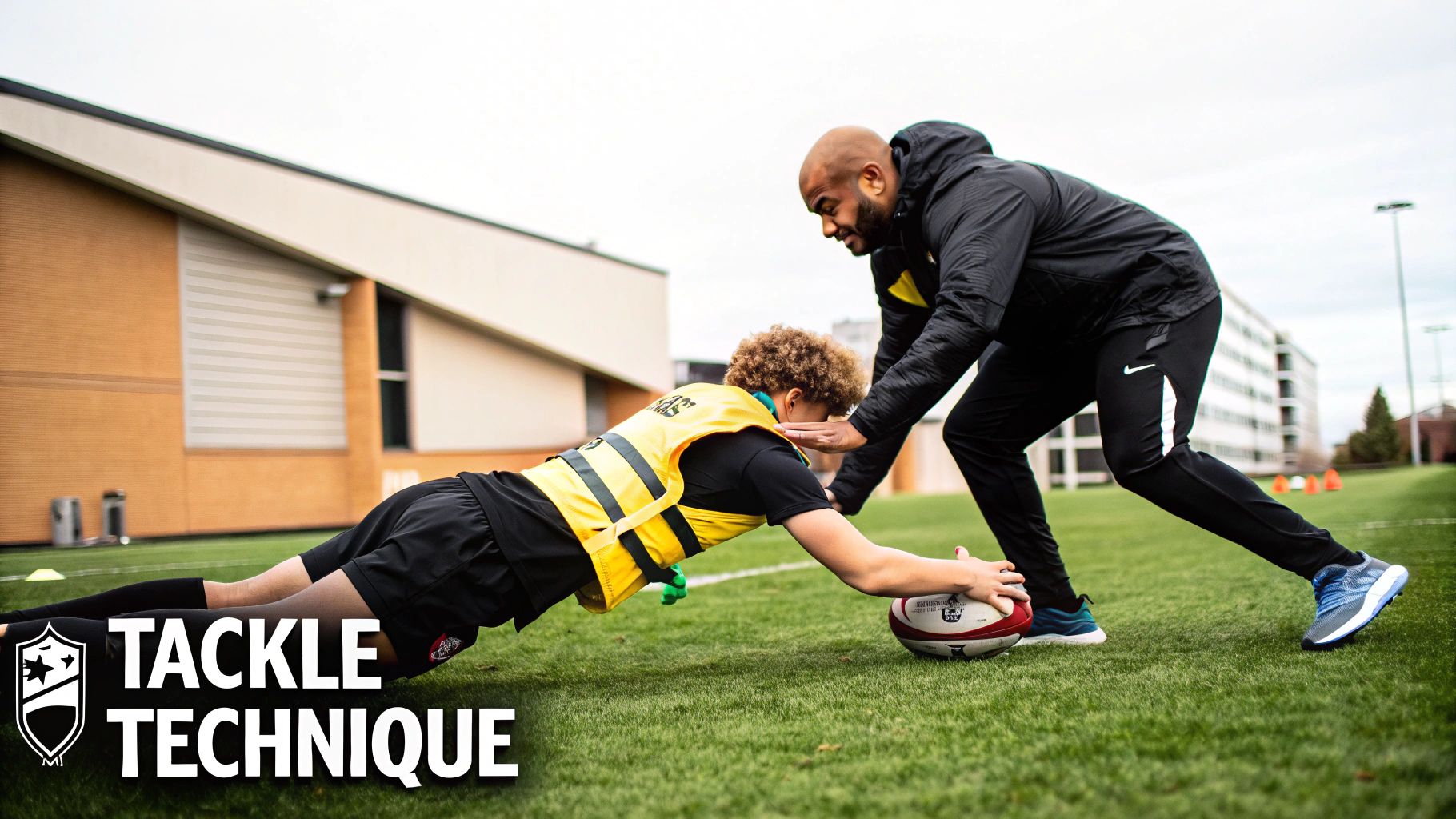
This drill directly addresses the high-risk, high-reward nature of tackling. Elite coaching organisations systematically integrate these drills to develop defenders who are not just physically imposing but also technically proficient, understanding precisely when and how to commit to a challenge. The goal is to create defenders who can confidently win the ball in critical one-on-one situations.
How to Implement the Drill
A safe and progressive setup is key to building confidence and correct muscle memory for tackling.
- Objective: To develop the correct, safe, and effective technique for both standing and sliding tackles, focusing on timing and ball-winning.
- Equipment: A few footballs, cones to mark a channel, and essential protective gear like premium shin guards.
- Setup: Create a 15-metre long, 5-metre wide channel with cones. A player with a ball (the attacker) starts at one end, and the defender starts in the middle. For beginners, use training dummies or start with a passive attacker.
- Execution: The attacker dribbles slowly through the channel. The defender's job is to close the space and execute a standing or sliding tackle to win the ball. The focus is purely on the technique of the tackle itself, not on a prolonged duel. Start at 50% speed and gradually increase the intensity as technique improves.
Coaching Cue: "For a sliding tackle, lead with the outside leg to block, and use the inside leg to 'hook' the ball. Keep your tackling leg's ankle locked and aim to make contact with the ball, not the player."
Progressions and Variations
Once the basic technique is established, you can make the drill more game-realistic.
- Semi-Active Opposition: The attacker can now attempt to evade the tackle with a simple change of direction, forcing the defender to adjust their timing.
- Add a Target: After winning the ball, the defender must immediately make a pass to a coach or a small target goal, reinforcing the transition from defence to attack.
- Video Analysis: Film the players' tackling technique from different angles. Reviewing the footage helps identify subtle errors in body shape, approach angle, or timing that are difficult to spot in real-time.
8. Transition Defence Drill (Counter-Press)
The transition defence drill, often focused on counter-pressing or "gegenpressing," is a high-intensity exercise that teaches a team to react instantly upon losing possession. Instead of retreating into a defensive shape, players are trained to immediately swarm the ball carrier to win it back. This is one of the most vital modern soccer defence drills because it turns a moment of vulnerability—losing the ball—into an attacking opportunity by regaining possession high up the pitch while the opposition is disorganised.
This drill focuses on the psychological switch from attack to defence, encouraging an aggressive, front-foot mentality. World-class managers like Jürgen Klopp have built their philosophies around this concept, famously stating, "The best moment to win the ball is immediately after your team just lost it." The relentless counter-pressing systems seen at top clubs are a testament to how effective this proactive defensive strategy can be, overwhelming opponents before they can launch a counter-attack.
How to Implement the Drill
Setting up a transition defence drill requires high tempo and clear triggers for the players.
- Objective: To improve the speed of defensive transition, the ability to press immediately after losing the ball, and regain possession in the attacking half.
- Equipment: A set of training cones and one football.
- Setup: Create a 30x20 metre grid. Set up two mini-goals at one end. Start with a 4v2 scenario inside the grid, where the team of four (attackers) aims to complete a set number of passes (e.g., 5) before trying to score in the mini-goals. The two defenders try to intercept the ball.
- Execution: The attacking team of four keeps possession. If the two defenders win the ball, they immediately try to dribble out of the opposite end of the grid. The four attackers must instantly transition to defence and press aggressively to prevent them from escaping. Rotate players and roles every few minutes.
Coaching Cue: "Don't just chase, press intelligently. The nearest player applies pressure to the ball, while others cut off passing lanes. Work together to close the space and force an error."
Progressions and Variations
To increase complexity and game realism, introduce these progressions:
- Increase Numbers: Progress the drill to 4v3, 5v4, or even 6v4 to create more realistic game scenarios and challenge communication.
- Add a Time Limit: Give the counter-pressing team a time limit (e.g., 5-7 seconds) to win the ball back, reinforcing the need for immediate and intense pressure.
- Monitor Intensity: Use GPS trackers to measure player work rates during the press. This data provides valuable insight into player fitness and effort, which you can learn more about on our blog.
8-Drill Soccer Defence Comparison
| Drill | 🔄 Implementation Complexity | ⚡ Resource Requirements | 📊 Expected Outcomes | Ideal Use Cases | ⭐ Key Advantages | 💡 Coach Tips |
|---|---|---|---|---|---|---|
| 1v1 Marking Drill | Low–Medium — simple setup, scalable progressions | Minimal — cones, ball, small grid | Improved one-on-one defending, anticipation, distance control | Individual defensive skill work, warm-ups, youth coaching | ⭐ Direct match transfer; confidence in duels | 💡 Start 10x10 m grid, rotate roles, use video for feedback |
| Pressing and High Defensive Line Drill | High — requires coordinated triggers and timing | High — full unit, large space, GPS/trackers optional | Regain possession high, compressed play, improved team pressing | Teams implementing high press / possession systems | ⭐ Forces turnovers; boosts team cohesion | 💡 Define pressing triggers, practice 2v2→3v3, manage recovery intervals |
| Defensive Shape and Positioning Drill | Medium — tactical teaching and repetition needed | Moderate — cones/markers, goalkeeper, video tools | Compactness, fewer gaps, better offside management | Building team defensive organization and formation work | ⭐ Stability and system understanding | 💡 Use markers for zones, progress static→dynamic, review with video |
| Defensive Block and Barrier Drill | Low–Medium — straightforward but safety-critical | Moderate — balls, rebounders, protective gear recommended | Improved set-piece defense, blocking timing, goalkeeper coordination | Set-piece preparation (free kicks, corners) | ⭐ Directly reduces set-piece goals | 💡 Use protective gear, vary distances, rotate positions and GK |
| Recovery and Covering Drill | Medium — tactical timing plus high physical demand | High — fitness levels required, GPS useful for monitoring | Faster recovery runs, better cover decisions, fewer isolated situations | Teams emphasizing pressing or recovering from errors | ⭐ Enhances defensive resilience and support play | 💡 Progress scenarios, monitor load, emphasize covering communication |
| Small-Sided Game Defensive Focus (4v4, 5v5) | Medium — requires rule management to target goals | Moderate — small goals, cones, reduced pitch | Realistic decision-making, many defensive actions per session | Youth development, applying principles under pressure | ⭐ High realism and engagement; frequent repetitions | 💡 Modify rules to focus defense, record sessions, rotate teams |
| Sliding and Tackling Technique Drill | Medium — technical focus needing close supervision | Moderate — padded gear, safe grass surface, coach oversight | Safer tackles, improved timing, fewer fouls and injuries | Individual technique coaching, injury-prevention sessions | ⭐ Improves technique and reduces foul risk | 💡 Always use protection, progress from passive→active, video analyze |
| Transition Defense Drill (Counter-Press) | High — intense collective timing and triggers | High — many players, high fitness, monitoring equipment | Immediate pressure after loss, quick turnovers, dynamic cohesion | Teams practicing gegenpress or quick transitions | ⭐ Produces fast turnovers and offensive opportunities | 💡 Start with 2v2/3v3, closely monitor intensity, ensure recovery |
Putting It All Together: Your Blueprint for Defensive Excellence
Mastering the art of defending isn't about a single, magic formula. It is a continuous journey built on repetition, intelligent application, and relentless dedication. The comprehensive suite of soccer defence drills we've explored provides a foundational blueprint for transforming any player or team from a reactive backline into a proactive, impenetrable unit. By moving from individual skills to collective strategy, you create a holistic defensive system where every player understands their role and the roles of those around them.
The journey begins with the individual. Drills like the 1v1 Marking Drill and the Sliding and Tackling Technique Drill are the bedrock of personal defensive competence. They instil the confidence and technical precision needed to win individual battles, which are the essential building blocks of any successful team performance. Without the ability to effectively challenge an opponent and dispossess them cleanly, even the most organised team shape will eventually falter under pressure.
From Individual Skill to Collective Strength
Once individual foundations are secure, the focus must shift to the collective. This is where drills focusing on shape, pressing, and recovery become paramount. The Defensive Shape and Positioning Drill, for instance, teaches players the crucial art of moving as a single, cohesive unit, denying space and forcing opponents into predictable, less dangerous areas. It’s about creating a living, breathing wall that adapts to the flow of the game.
Similarly, the Pressing and High Defensive Line Drill and the Transition Defence Drill (Counter-Press) introduce an aggressive, front-foot mentality. These exercises are vital for modern football, teaching teams not just to absorb pressure but to actively create it, winning the ball back high up the pitch and turning defensive actions into immediate attacking opportunities. This proactive approach can demoralise opponents and dictate the tempo of the entire match.
Key Takeaway: The most effective defensive systems are built on a pyramid of skills. Individual technical ability forms the base, small-group understanding forms the middle, and full-team tactical cohesion sits at the pinnacle. Neglecting any layer will compromise the entire structure.
Actionable Steps for Implementation
To truly leverage these soccer defence drills, consistency is your greatest ally. Don't treat them as a one-off session. Instead, weave them into your regular training schedule. A great approach is to dedicate specific training days to particular defensive themes.
- Week 1: Focus on individual skills (1v1s, tackling).
- Week 2: Introduce small-group concepts (recovery runs, pressing triggers).
- Week 3: Work on full-team shape and organisation.
- Week 4: Integrate everything in realistic, game-like scenarios (small-sided games).
This cyclical approach ensures that skills are not only learned but are constantly reinforced and refined. Furthermore, remember that the physical demands of modern defending are immense. To truly achieve defensive excellence, integrating principles of functional strength training is vital for developing the dynamic movement, core stability, and explosive power needed on the field.
Ultimately, the drills in this guide are your tools. How you use them will define your success. Encourage constant communication, demand maximum concentration, and foster an unwavering commitment to the team's defensive goals. By implementing these exercises with passion and precision, you're not just coaching defence; you're forging the unshakeable foundation upon which victories are built.
Ready to put these drills into practice? Equip your team for success with high-quality training gear from SoccerWares. From durable cones and agility ladders to professional-grade bibs and performance-tracking technology, we have everything you need to run effective and engaging soccer defence drills. Visit SoccerWares today and build the foundation for your team's defensive dominance.